Hundreds of Millions of Dollars Have Been Recovered for Personal Injury and Wrongful Death Victims
"*" indicates required fields
Losing a family member is the hardest thing anyone ever endures, and the pain is even greater when that loss is caused by someone else’s negligence or recklessness. This is specifically for families who have lost a loved one in California and are seeking answers about their legal rights, the claims process, and how to secure justice and financial stability after a wrongful death. If you are searching for a California wrongful death lawyer or want to understand your rights after a tragic loss, our wrongful death lawyers will guide you through the legal process, eligibility requirements, available damages, and support resources. Understanding wrongful death law matters because it empowers families to hold responsible parties accountable and helps ensure the financial security of those left behind.


At The Killino Firm, we know that a sudden tragedy leaves families with immediate, overwhelming questions. We believe in providing more than just legal representation; we provide a roadmap for the days ahead. For each of the communities listed below, we have compiled specific local resources to help you navigate this difficult time. This includes information on which hospitals provide emergency trauma services, which local courts would handle your case, and the specific risks associated with that area. Most importantly, we connect you with the support organizations ready to help you heal.
A California wrongful death lawyer can help families understand their rights and pursue accountability, assist in gathering evidence and building a case for compensation, and help level the playing field against insurance companies. The wrongful death claim process can be complex and often requires experienced legal representation. In California, only specific individuals may file a wrongful death claim, typically the decedent’s surviving family members. A wrongful death claim can help provide financial security for the surviving family members.


Wrongful death is a distinct area of personal injury law that requires different evidence than standard injury claims. These cases arise when a person dies due to the negligence or misconduct of another person or party.
In California, a wrongful death claim is a civil action brought by survivors against a person or entity who caused a death through negligence, recklessness, or intentional harm.
The legal authority for these claims is found in California Code of Civil Procedure (CCP) § 377.60. This statute authorizes specific surviving family members to file a lawsuit seeking compensation for the personal losses they have suffered due to the death.
To succeed, our team of wrongful death lawyers must prove four key elements:
Duty of Care: The defendant owed a duty to the deceased (e.g., a driver’s duty to follow traffic laws or a doctor’s duty to follow the standard of care).
Breach of Duty: The defendant failed that duty, which may involve someone else’s negligence.
Causation: The breach must directly cause the person to die.
Damages: The survivors suffered actual financial or emotional loss.
The legal process requires our wrongful death legal team to prove these elements to succeed in a wrongful death claim. In wrongful death cases, the family may need to prove that the death was caused by the negligence or wrongful act of another party.
It is vital to distinguish between a standard wrongful death claim and what the law calls a “Survival Action.” While wrongful death focuses on the loss felt by the family, a survival action focuses on the losses suffered by the victim.
Authorized under California Code of Civil Procedure § 377.30, a survival action allows the estate to recover damages that the deceased would have been entitled to had they lived. This typically includes the medical bills incurred between the accident and the death, as well as property damage (like a wrecked vehicle).
Next, we’ll discuss who is eligible to file a wrongful death claim in California.


Not everyone who loved the deceased is eligible to file a lawsuit. California law is very specific about the “hierarchy” of plaintiffs.
According to the statute, the following parties have standing to sue, in this order:
The Surviving Spouse or Domestic Partner has the primary right.
Children: Biological and adopted children.
Grandchildren: If the children of the deceased are already deceased.
Dependents: Anyone who was financially dependent on the deceased for at least 50% of their support (this can include parents or stepchildren).
Next of Kin: If none of the above exist, the claim falls to those who would inherit the estate under California intestate succession laws (usually parents or siblings).


While the law treats “wrongful death” as a single legal concept, the causes behind these tragedies are vastly different. At The Killino Firm, we don’t just process claims; we investigate the specific mechanics of the accident. We look for the patterns.
California’s unique infrastructure—our massive port systems, our twelve-lane highways, and our dense urban centers—creates specific risk profiles. Based on state data and our decades of experience, here is a deeper look at the accidents that most frequently result in fatal outcomes.


California is the logistics heartbeat of the nation. But that economic engine comes with a deadly cost.


California is facing a pedestrian safety crisis that is outpacing the rest of the country.


California is the only state where “lane splitting” is explicitly legal, yet it remains a point of contention and danger.


We trust doctors with our lives, but the medical system is prone to systemic errors.


Sometimes the danger is inside your own home. When a manufacturer cuts corners to save pennies, consumers pay with their lives.


With massive development projects across the state, construction sites are common scenes of tragedy.


In a state with thousands of residential pools and miles of coastline, drowning is a significant risk, particularly for children.


While we talk about unique risks like industrial accidents or defective products, the grim reality is that standard car accidents remain the most frequent cause of wrongful death we encounter.


When you step onto someone else’s property—whether it is a grocery store, a hotel, an apartment complex, or a parking garage—you have a legal right to be safe. When property owners prioritize profits over maintenance, fatal accidents happen.
Now that you understand the common causes and the data behind them, the next step is understanding what the law allows you to recover. Let’s explore the damages available to grieving families in California.
When you search for the “best” outcome for your family, you are really looking for future stability. In California, the law is very specific about how that stability is calculated.
According to the official Judicial Council of California Civil Jury Instructions (CACI No. 3921), damages in a wrongful death case are divided into two distinct categories:
Economic Damages (Calculable Financial Losses)
These are tangible financial losses that can be calculated on a spreadsheet and documented by forensic economists. Under California law, this includes:
2. Non-Economic Damages (The Value of the Relationship) In most wrongful death cases—particularly those involving children or non-wage earners—non-economic damages form the largest part of the financial recovery. According to legal analysis published in Advocate Magazine, “in the overwhelming majority of cases, the value assigned to these categories will be the largest portion of the verdict.”
While California law does not compensate for “grief” or “sorrow,” California Civil Jury Instruction (CACI) No. 3921 specifically allows the jury to award damages for the loss of the positive benefits of the relationship, including:
Understanding damages is crucial—next, we’ll cover the strict deadlines for filing a wrongful death claim in California.


In the legal world, time is the enemy of evidence. California law enforces strict deadlines, known as Statutes of Limitations. If you miss this window, the courts will likely bar your case forever, regardless of how clear the negligence was.
Why You Should Not Wait: Beyond the legal deadlines, there is a practical reality: evidence disappears. Skid marks fade, surveillance footage is taped over, and witnesses move away. Our team of wrongful death lawyers acts immediately to preserve this evidence before it is lost.
After understanding the time limits, it’s important to know where victims are treated and where your case may be heard.


In the aftermath of a catastrophic accident, victims are usually transported to Level I or Level II Trauma Centers. Knowing where your loved one was treated is vital for obtaining medical records to build your case. Here are the primary trauma hubs in California:
Southern California
Northern California / Bay Area
Once medical care is provided, the next step is understanding where your legal case will be heard.


Venue matters. We generally file suit in the county where the accident occurred or where the defendant resides. We are familiar with the local rules and procedures in courts across the country.
After learning about the legal venues, it’s important to know what support resources are available for grieving families.


When tragedy strikes “near me,” legal help is only one piece of the puzzle. We encourage families to seek emotional support during this time.
With support resources in mind, let’s address some of the most frequently asked questions about wrongful death cases in California.

We know there are many choices when you search for legal help. However, catastrophic injury and high-stakes litigation present unique challenges that go beyond standard claims. These complex matters require a team that commands the intricacies of the legal system, possesses the resources for deep forensic investigation, and understands the advanced strategies required to win in the courtroom.
At The Killino Firm, our team of wrongful death lawyers is nationally recognized for going the extra mile. We have taken on major corporations and won. If you have lost a loved one, do not face the insurance companies alone. Let us handle the legal burden so you can focus on healing.
Disclaimer: The information provided on this website page is for general informational purposes only and does not constitute legal advice. Every case is unique. Please consult with an attorney regarding your specific legal situation.


Yes. While you cannot claim “lost wages,” you can still claim “loss of services” (like childcare or housekeeping) and, more importantly, non-economic damages for the loss of their love, companionship, and guidance. The value of a stay-at-home parent or an elderly family member is significant in the eyes of the law.
We operate on a contingency fee basis. This means you pay zero upfront fees. We advance all costs for the investigation, experts, and filing fees. We only get paid a percentage of the settlement or verdict if we win your case. If we don’t win, you owe us nothing.
Not necessarily. The vast majority of wrongful death cases in California are settled before trial. However, our team prepares every case as if it is going to trial. This aggressive preparation is often what compels insurance companies to offer a fair settlement to avoid facing us in the courtroom.
If there is a single plaintiff (like a spouse), they receive the full amount. If there are multiple plaintiffs (e.g., a spouse and three adult children), the family can agree on how to divide the funds. If the family cannot agree, the court will hold a hearing to distribute the funds based on each person’s financial and emotional loss.
You can still sue. The criminal court requires proof “beyond a reasonable doubt.” Civil court only requires a “preponderance of the evidence” (more likely than not). A notorious example is the O.J. Simpson case; he was acquitted criminally but found liable in the wrongful death civil suit.
Yes. If the accident and death occurred in California, the lawsuit is typically filed here, regardless of where the surviving family members live. Our team represents clients from all over the country who lost loved ones in California accidents.
In California, some counties use a Sheriff-Coroner (elected official, law enforcement based) while others use a Medical Examiner (appointed physician). Both are responsible for determining the cause of death. Their official report is a critical piece of evidence that our team analyzes to prove causation in your case.
Courtney S

Reggie B
Corey E
Jeanne Y
Trisha H
Michaelene C
Rhonda L
In the aftermath of a wrongful death or catastrophic injury, particularly those involving babies and children, victims and their families are forced into the new “normal”. Their lives are often characterized by multiple facets of struggle; physical, medical and financial. The worry and stress can be unbearable. But, that is where the Killino Firm steps in.
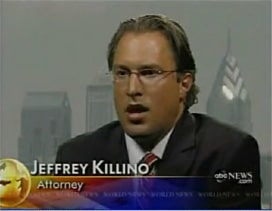
Time and again for over two decades Jeffrey Killino has changed the lives of his clients and their families with recoveries that will provide for all future medical care and day to day needs. The Killino Firm clients are regularly purchasing new homes and vehicles; securing much needed medical care and assistance; and sleeping better at night know there are millions of dollars to take care of them for the rest of their lives.
Yes, the Killino Firm regularly secures multi-million dollar settlements and/or verdicts, however, we measure our true success in terms of how we change our clients’ lives. The Killino Firm is dedicated to its clients and their plight. After the cases are over, the Killino Firm stays involved and available to it’s clients as the journey continues.
At the Killino Firm we care about our clients and we care about our community, which is why from time to time when we uncover a hazard or danger with the potential to harm others, the Killino Firm takes action to alert the public and appropriate regulatory authorities.
Call Me
We'll call you!
"*" indicates required fields
By submitting, you agree to be contacted about your request & other information using automated technology. Message frequency varies. Msg & data rates may apply. Text STOP to cancel. Privacy Policy
Text With Us
We'll text you!
"*" indicates required fields
By submitting, you agree to be contacted about your request & other information using automated technology. Message frequency varies. Msg & data rates may apply. Text STOP to cancel. Privacy Policy
Call Me
We'll call you!
By submitting, you agree to be contacted about your request & other information using automated technology. Message frequency varies. Msg & data rates may apply. Text STOP to cancel. Privacy Policy
Text With Us
We'll text you!
"*" indicates required fields
By submitting, you agree to be contacted about your request & other information using automated technology. Message frequency varies. Msg & data rates may apply. Text STOP to cancel. Privacy Policy
Email Us
We're available by email!
"*" indicates required fields
By submitting, you agree to be contacted about your request & other information using automated technology. Message frequency varies. Msg & data rates may apply. Text STOP to cancel. Privacy Policy
Book A Consultation
We're ready to answer your questions!
