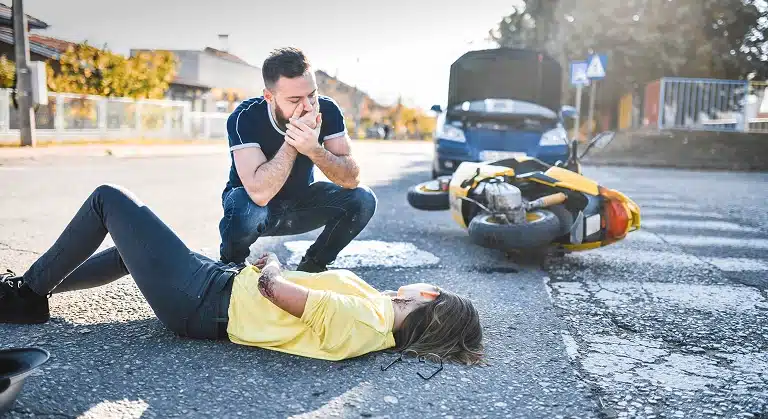
Getting blamed for a crash you didn’t cause — or being told you are partly responsible — is stressful enough without wondering whether it will hurt your case.
It doesn’t have to, not when the facts are on your side. You may still be able to recover compensation after a motorcycle accident even if you were partially at fault. The effect of your share of fault depends on the law of the state where the claim is brought.
For example, Pennsylvania follows a modified comparative negligence rule. A plaintiff’s damages are reduced according to their percentage of fault, but they generally cannot recover if their negligence is greater than the causal negligence of the defendant or defendants. California, by contrast, follows a pure comparative negligence approach, meaning a plaintiff’s damages are reduced according to their percentage of fault even if they are more than 50% responsible for the harm.
Florida previously followed a pure comparative negligence system, but a 2023 change to state law moved it to a modified comparative negligence system. Under Florida’s current rule, a party found more than 50% at fault for their own harm cannot recover damages in a negligence action.
That means an insurance company’s statement that you were “partly at fault” does not automatically end your claim.
What determines the value of a motorcycle accident case?
What is comparative fault?
Comparative fault is a legal rule used to divide responsibility when more than one person contributed to an injury.
Imagine that a jury determined:
- The other driver was 80% responsible.
- You were 20% responsible.
- Your legally recoverable damages were $100,000.
Under a system that reduces damages according to your percentage of fault, a 20% allocation could reduce a $100,000 recovery to $80,000. The actual rules depend on the state and the facts of the case.
Why insurance companies raise fault after motorcycle crashes

Motorcyclists often face a particular challenge after a crash: rider bias.
An insurance adjuster may argue that the rider was speeding, riding aggressively, lane splitting, following too closely, or otherwise caused the collision. Sometimes, there is legitimate evidence supporting a shared-fault argument. In other cases, the allegation is based on assumptions about motorcycle riders rather than evidence.
The distinction matters. Your case should be evaluated based on what actually happened, not on stereotypes about how motorcyclists ride.
Common arguments used to blame motorcycle riders
Insurance companies may raise several arguments when trying to assign some or all of the blame to a motorcycle rider, including:
Speed
Speed can be relevant to fault, but an allegation alone does not establish how fast you were traveling or whether your speed contributed to the collision.
Evidence should be examined carefully. Investigators may consider physical evidence, vehicle damage, witness statements, video footage, roadway conditions, and accident reconstruction evidence.
Lane position
An insurer may argue that you were in an unusual or unexpected position on the roadway. That does not automatically establish negligence. Your exact lane position, traffic conditions, visibility, and the actions of other drivers all matter.
Lane splitting
Lane splitting is treated differently from state to state.
California law defines lane splitting and permits it under the state’s traffic laws, while Pennsylvania prohibits operating a motorcycle between lanes of traffic or adjacent lines or rows of vehicles. Florida also prohibits operating a motorcycle between lanes or between adjacent lines or rows of vehicles.
Even when a rider violated this traffic rule, that does not necessarily resolve the question of liability. The evidence still needs to establish what caused the collision and what injuries resulted.
Failure to wear a helmet
Helmet use can become an issue when a rider suffers a head injury. But whether failure to wear a helmet affects a particular claim depends on state law and the relationship between the alleged violation and the injury.
The question is not simply whether you were wearing a helmet. For example, if the claim involves a leg injury, the insurer may have difficulty showing that helmet use affected that injury. The key question is whether the lack of a helmet contributed to the specific injury being claimed.
If you were partially responsible
Be honest with your lawyer about what happened. If you were speeding, changed lanes improperly, split lanes, or otherwise violated a traffic rule, that information should not be hidden. Your attorney needs the complete picture to evaluate how the law may apply. From there, they can investigate whether the other driver's conduct also contributed to the crash.
A driver who failed to yield, turned left across your path, changed lanes without checking, followed too closely, or drove while distracted may still bear substantial responsibility.
How is fault determined after a motorcycle accident?

Fault should be determined by the evidence, not simply by the version of events reported to an insurance company. Evidence that may help establish what happened includes:
- Police reports
- Photographs and video
- Traffic camera footage
- Motorcycle and vehicle damage
- Skid marks
- Debris patterns
- Electronic vehicle data when available
- Witness statements
- Cell phone evidence when legally obtainable
- Roadway and visibility conditions
- Accident reconstruction
- Motorcycle and vehicle inspections
This is one reason early investigation matters. Physical evidence can disappear, vehicles can be repaired or sold, and witnesses can become difficult to locate, which is why we move quickly to preserve it.
What if the other driver says, "I didn't see the motorcycle"?
A driver saying they did not see you does not automatically establish that you caused the crash.
Depending on the circumstances, a driver’s failure to notice a motorcycle may be evidence that the driver failed to keep a proper lookout. The relevant question is what a reasonable driver should have seen and done under the conditions at the time.
- Was the motorcycle already in the driver’s path?
- Did the driver check before changing lanes?
- Was the driver turning across the motorcycle’s path?
- Was anything obstructing the driver’s view?
Those questions should be answered with evidence, not assumptions.
What if more than one person was at fault?
Sometimes, more than two parties can contribute to a motorcycle crash. Potentially responsible parties may include:
- Another driver
- A commercial trucking company
- A vehicle or motorcycle manufacturer
- A motorcycle parts manufacturer
- A negligent mechanic
- A property owner
- A government entity responsible for roadway maintenance
A defective component can also complicate a crash. A problem involving a brake, tire, throttle, or another part could contribute to the collision or make the resulting injuries worse.
Our experienced team will investigate those underlying causes rather than stopping at the police report. Identifying all the factors that contributed to the crash can help determine who may be responsible and build a stronger case for the compensation you deserve.
What if more than one person was at fault?

No. In fact, disputed faults can make legal advice more important. Insurance companies have a financial incentive to reduce their exposure. If an adjuster assigns you 30% of the blame, you should understand what evidence supports that number and how your state’s law treats comparative fault. An insurer’s fault assessment is not necessarily the same as the legal determination of liability. That is where a closer review can make a difference. The Killino Firm can examine the fault determination, gather independent evidence, and push back on any percentage that isn’t supported by the facts.
Frequently asked questions
Can I sue if I was partly at fault for a motorcycle accident?
Possibly. Many states allow an injured person to recover some compensation even when that person contributed to the crash, although the amount may be reduced or recovery may be barred depending on the state's comparative fault rules.
What if the other driver was mostly at fault?
You may still have a claim. The percentage of fault assigned to each party can affect the amount of compensation available.
Does speeding automatically make a motorcycle rider responsible?
No. Speed may be relevant to fault, but responsibility depends on the facts and applicable law. Investigators should determine whether and how the speed actually contributed to the crash.
Get the facts investigated
If an insurance company is blaming you for a motorcycle crash, do not assume you have no claim.
The Killino Firm motorcycle accident lawyers can investigate liability, examine the available evidence, and help you understand how comparative fault may affect your case. Reach out to our team today for confidential legal review.