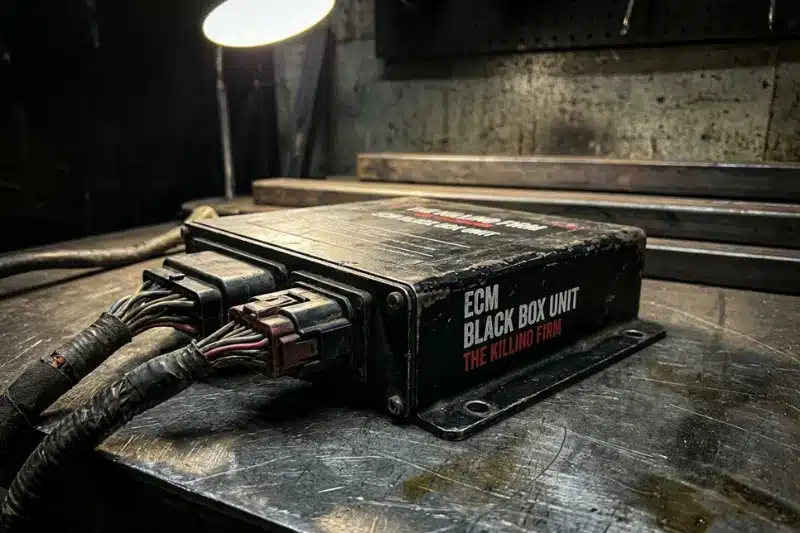
The clock isn’t just ticking for your physical recovery after a Philadelphia truck accident—it is actively running out on the evidence required to prove your case. Crucial electronic black box (ECM) data can begin overwriting itself within hours of a collision, and trucking companies are under no automatic obligation to save it. For victims and families fighting for accountability, mapping this rapid timeline, enforcing immediate evidence preservation, and executing the right legal steps on day one are the only ways to protect your rights before the truth vanishes.
How Fast Do Trucking Companies Destroy Black Box (ECM) Data?
Trucking companies operating in and around Philadelphia can, in some instances, legally allow black box (ECM/EDR) data to be overwritten or purged within 30 to 90 days of a commercial vehicle crash. In many cases, critical data loops begin erasing themselves automatically within hours of the collision.
Philadelphia sits at the intersection of I-95, I-76, I-676, and the New Jersey Turnpike extension, making it one of the highest-volume commercial freight corridors on the entire East Coast. Because the area is a vital artery for the regional and national trucking industry, the stakes for evidence preservation here are exceptionally high. At The Killino Firm, our truck accident lawyers dispatch spoliation-of-evidence letters and, when necessary, emergency court filings within 24 hours of being retained. We understand precisely how fast the electronic evidence that wins these cases disappears
Key Takeaways
Hours vs. Days: ECM data can begin overwriting within minutes of a Philadelphia truck crash if the vehicle continues operating, or within 30 days if the system’s trip buffer fills.
Not Always an Automatic Duty: Trucking companies do not always have an automatic legal duty to preserve black box data after an accident unless they receive a formal, written legal hold demand.
The Evidentiary Paradox: Pennsylvania’s statute of limitations for personal injury claims is two years (42 Pa. C.S. § 5524), but waiting even two weeks to act can permanently destroy your strongest evidence.
Local Rules Matter: Philadelphia truck accident cases are filed in the Philadelphia County Court of Common Pleas, where local evidentiary rules and court procedures directly govern how spoliation sanctions are applied.
Federal Regulatory Gaps: Federal FMCSA regulations (49 CFR Part 390) set recordkeeping minimums for carriers, but no federal rule mandates the permanent preservation of raw ECM data for the benefit of accident victims.
Immediate Mobilization: The Killino Firm’s catastrophic injury legal team moves immediately—retaining accident reconstruction experts, filing emergency preservation motions, and pulling FMCSA violation histories before the carrier’s legal team can reset the narrative.
What Exactly Is a Truck's Black Box, and What Data Does It Capture?
A commercial truck’s Electronic Control Module (ECM)—commonly known as the “black box”—is an onboard computer that runs continuously, recording mechanical and operational performance. Unlike a standardized airplane flight recorder, truck ECMs vary significantly by manufacturer (Freightliner, Peterbilt, Kenworth, Volvo, International). What data is stored and for how long depends entirely on that truck’s specific configuration.
Furthermore, this data isn’t limited to standard tractor-trailers. Amazon/FedEx delivery vans, city dump trucks, cement mixers, and commercial box trucks that crowd the I-95 and I-76 corridors daily also use these electronic logging systems.
For an accident on I-95 near the Girard Avenue interchange, the Delaware Avenue corridor, or the I-76 Schuylkill Expressway, the ECM records every second leading up to impact. Because fully loaded commercial trucks can weigh 80,000 pounds or more, this data is vital to proving liability when a collision causes catastrophic injuries. The recorded data typically includes:
Pre-crash vehicle speed: Often the single most damaging piece of evidence against a speeding carrier.
Engine RPM and throttle position: Showing driver behavior at the exact time of impact.
Brake application timing and pressure: Verifying sudden braking sequences and whether a devastating jackknife accident was triggered by abrupt or improper braking by the truck driver.
Hard braking and acceleration events: Documenting erratic driving in the hours leading up to the crash.
Seatbelt engagement status: Tracking driver safety compliance.
GPS location coordinates: Tracked down to the exact second.
Cruise control status: Shows whether it was engaged through active construction zones or congested highway sections.
Fault codes: Pre-existing mechanical warnings and engine errors that the carrier may have deliberately ignored.
Hours of service indicators: Providing initial objective evidence of driver fatigue.
According to the National Highway Traffic Safety Administration (NHTSA), Event Data Recorders in commercial vehicles capture pre-crash dynamics that represent the most compelling objective evidence available in modern crash litigation.
Urgent Warning for Accident Victims
The Case Results That Matter Cost You Nothing Out of Pocket
Trucking companies and their insurance carriers deploy rapid response teams to the accident scene within hours to mitigate their financial exposure. Protecting your rights requires an equally aggressive response.
The Killino Firm handles all catastrophic truck accident claims on a contingency fee basis—meaning you pay absolutely nothing out of pocket, and we cover all upfront investigative costs. No fee unless we win.
📞 Call The Killino Firm immediately
How Quickly Can Black Box Data Disappear?
Philadelphia’s dense highway network means commercial trucks involved in crashes are often quickly towed away to private carrier lots in South Philadelphia, Northeast Philadelphia, or across the Delaware River to New Jersey. Once there, they are out of public view and beyond easy reach without immediate legal process.
Does ECM Data Overwrite Itself Without Anyone Touching the Truck?
Yes. Many ECMs operate on a continuous recording loop that overwrites the oldest stored data as new data accumulates.
Continuous Operations: Some ECMs overwrite within 30 seconds to a few minutes if the truck keeps running or is driven away from the scene before police arrive—a common scenario that can wipe out data regarding pre-crash speed and braking patterns.
Trip Buffers: Standard trip data buffers typically purge automatically within 30 days once a new trip cycle begins.
Hard-Event Snapshots: Data triggered by severe deceleration or deployment of safety systems may persist longer, but only if the system successfully flagged and locked the snapshot, and only if no one manually clears the module. This electronic data is critical in proving fault in high-speed rollover accidents or sharp-turn collisions.
ELD Data Limitations: Electronic Logging Device (ELD) data, required under 49 CFR § 395.15, must be retained by carriers for just six months—after which federal law imposes no obligation to keep it.
Fleet managers and dispatchers with access to the truck’s telematics system can also manually clear ECM data remotely. Without a formal preservation demand in place, there is little stopping them from purging the system.
What Federal Regulations Actually Govern Trucking Data Retention?
The Federal Motor Carrier Safety Administration (FMCSA) establishes minimum retention periods for carrier records. However, these rules exist to ensure regulatory compliance, not to protect injured victims.
|
Record Type
|
Required Retention Period
|
|---|---|
|
Driver logs (paper)
|
6 months
|
|
ELD data
|
6 months
|
|
Driver qualification files
|
Duration of employment + 3 years
|
|
Inspection, repair & maintenance records
|
1 year (or until vehicle is sold)
|
|
Accident register
|
3 years
|
|
ECM / Black Box raw data
|
No specific federal minimum
|
Beyond these record-retention rules, federal law mandates a minimum liability insurance coverage of $750,000 for interstate commercial trucks (and significantly higher for hazardous materials). Because the policy limits are so high, a commercial truck accident claim is defended with far more aggressive legal tactics than an ordinary passenger vehicle case.
As shown above, no federal regulation requires a trucking company to preserve raw ECM data after a crash. A carrier can legally allow that data to overwrite, purge, or be manually cleared unless a court order or properly served legal hold demand is already in place.
What Is a Spoliation of Evidence Letter?
A spoliation letter is a formal legal notice sent by our truck accident lawyers to the carrier, its insurer, and all relevant third parties, demanding the immediate preservation of all physical, digital, and electronic evidence connected to the crash.
Once received, the trucking company is on strict legal notice. If they allow evidence to be destroyed after that point, they face Pennsylvania’s spoliation doctrine, which carries severe judicial consequences:
Adverse Inference Instructions: The Philadelphia jury is explicitly instructed to assume the destroyed evidence would have harmed the trucking company’s case.
Case-Dispositive Sanctions: Under Pennsylvania Rule of Civil Procedure 4019, the court may strike the defendant’s answers and defenses entirely.
Default Judgment: In egregious cases of intentional, bad-faith destruction, the court can rule entirely in favor of the plaintiff before trial even begins.
Philadelphia County Court of Common Pleas judges—particularly those sitting in the Complex Litigation Center at 34 S. 11th Street—have wide discretion to impose these sanctions and can do so in commercial vehicle cases where carriers failed to safeguard electronic evidence.
Our catastrophic injury legal team sends spoliation letters within hours of being retained. We direct them simultaneously to:
The trucking company’s registered agent and corporate executives.
The carrier’s primary and excess insurance companies.
The fleet management company or third-party telematics/ECM vendor.
The freight broker who contracted and routed the load.
The truck’s independent maintenance contractor, if a mechanical failure is suspected.
In cases where the carrier is unresponsive or data loss is imminent, we may file an emergency motion for a temporary restraining order and preservation order directly in the Philadelphia County Court of Common Pleas—forcing the carrier to secure the vehicle under penalty of contempt.
What Other Evidence Disappears Fast in Philadelphia Truck Accident Cases?
While the black box is a high-priority target, it is not the only evidence that begins vanishing within hours of a Philadelphia crash. Our legal team moves on multiple fronts simultaneously to secure crucial evidence.
Traffic and Surveillance Camera Footage: A 72-Hour Window
Philadelphia is covered by an extensive network of traffic cameras managed by the Philadelphia Streets Department and the Pennsylvania Department of Transportation (PennDOT). Thousands of private security cameras also line businesses along I-95 frontage roads, the Columbus Boulevard corridor, Aramingo Avenue, and the industrial zones of Port Richmond and Bridesburg.
Most of this footage is stored on rolling loops of 24 to 72 hours, after which it is automatically overwritten. Our team contacts camera operators and public agencies immediately to issue written preservation demands on day one.
Driver Records That Expose Hours-of-Service Violations
Driver fatigue is a documented danger on Philadelphia’s highways. The FMCSA Large Truck Crash Causation Study identified driver fatigue as a major contributing factor in fatal commercial truck crashes nationwide. For trucks entering Philadelphia via I-95 from the south or via the Pennsylvania Turnpike from the west, drivers may have been behind the wheel for hours before reaching city limits.
Federal hours-of-service rules under 49 CFR Part 395 cap driving at 11 hours within a 14-hour on-duty window—yet carriers routinely pressure drivers to falsify logs. Driver records can also reveal distracted driving, log discrepancies, and alcohol-related violations (commercial drivers face a strict legal blood alcohol concentration limit of 0.04%). We seek and subpoena:
ELD records and all underlying raw telematics data.
Paper backup logs from the days before the crash.
Toll transponder records from the Pennsylvania Turnpike, I-95 E-ZPass system, and Delaware River Port Authority crossings to independently verify log accuracy.
Fuel and lodging receipts are timestamped against the driver’s claimed log entries.
Cell phone records showing calls, texts, or data usage during driving hours to prove negligence.
Maintenance Records and Improper Cargo Loading
Under 49 CFR Part 396, carriers must conduct pre-trip inspections and maintain complete repair logs. When a brake failure, steering defect, or tire blowout contributes to a crash, these records offer a direct path to proving the carrier chose corporate profit over public safety.
Furthermore, improper cargo loading routinely leads to devastating truck accidents by shifting weight, destabilizing the trailer, or worsening braking failures. We investigate whether cargo loaders, warehouse companies, or freight brokers created unsafe conditions by violating loading rules, subpoenaing maintenance logs, driver vehicle inspection reports (DVIRs), and repair shop invoices, and then conducting depositions of the fleet mechanics under oath.
Dashcam and Cab-Facing Video
Many commercial fleets operating through Philadelphia carry forward-facing and cab-facing dashcam systems that record continuously. This footage is typically stored on a short, 72-hour rolling loop. A truck involved in a crash Monday morning may have its internal and external dashcam footage completely overwritten by Thursday if the vehicle remains in service or power is not cut. We act before that window closes.
How Does Pennsylvania Law Protect Truck Accident Victims?
Philadelphia truck accident victims have two years from the date of injury to file a personal injury lawsuit under 42 Pa. C.S. § 5524. Wrongful death and survival actions carry the same two-year deadline under 42 Pa. C.S. § 5524(2). While two years may feel generous, it is a deceptively short window. Complex truck accident cases involve corporate defendants with national legal teams, federal regulatory records spread across multiple jurisdictions, and electronic evidence that begins disappearing before the ambulance leaves the scene.
Where Are Philadelphia Truck Accident Lawsuits Filed?
Most Philadelphia truck accident lawsuits are filed in the Philadelphia County Court of Common Pleas, located at City Hall, or in the Complex Litigation Center at 34 S. 11th Street for cases meeting that program’s jurisdictional threshold. Cases involving defendants across state lines or interstate regulations may also be filed in the United States District Court for the Eastern District of Pennsylvania at 601 Market Street.
Venue matters immensely in truck accident litigation. Philadelphia County juries have historically held large corporate defendants to a high standard of accountability. Our catastrophic injury legal team knows this court, its system, and its precise local procedures.
What Damages Can Be Recovered?
Pennsylvania follows a modified comparative negligence standard under 42 Pa. C.S. § 7102. You can recover full damages as long as your percentage of fault does not exceed 50%. However, insurance adjusters often manipulate early statements to shift blame, which can negatively impact your settlement. In a Philadelphia commercial truck accident involving serious injuries, recoverable damages include:
Economic damages: Emergency medical expenses, ongoing medical bills, specialized medical treatment, long-term physical therapy, lost wages, diminished earning capacity, in-home nursing care, rehabilitation, permanent disability accommodations, and compensation for vehicle and personal property damaged in the crash.
Non-economic damages: Physical pain and suffering, emotional distress, loss of consortium, and loss of life’s pleasures.
Punitive damages: Available when a defendant’s conduct was outrageous or showed willful disregard for public safety—a legal threshold that deliberate evidence destruction or driving grossly over hours-of-service limits can satisfy.
To establish liability clearly in a truck accident lawsuit, proving a direct violation of FMCSA trucking regulations can establish negligence per se, effectively locking in the carrier’s liability.
How The Killino Firm Responds on Day One
The Killino Firm does not wait for the insurance company to run its internal investigation and deliver a lowball settlement figure designed to protect the carrier. We mobilize immediately and decisively.
Within the First 24 Hours:
Send certified spoliation of evidence letters to the carrier, insurer, ECM vendor, and telematics company.
Contact the Philadelphia Streets Department and PennDOT to demand traffic camera footage before it overwrites.
Retain an independent, court-qualified accident reconstruction expert to inspect the accident scene and analyze vehicle damage.
Dispatch field investigators to photograph physical evidence—skid marks, debris patterns, road defects, signage, and guardrail damage.
Secure 911 call recordings, police CAD logs, and Philadelphia Police Department crash reports.
Within the First Week:
Issue subpoenas for ELD records, maintenance logs, and driver qualification files.
File emergency preservation motions in the Philadelphia County Court of Common Pleas if the carrier proves non-responsive.
Pull the carrier’s FMCSA Safety Measurement System (SMS) scores and full inspection violation histories.
Retain a biomechanical expert to document injury causation and force of impact.
Identify all potentially liable parties. In complex truck accident cases, liability often extends beyond the truck driver and trucking company to include companies responsible for loading cargo, vehicle maintenance contractors, component manufacturers, or the freight brokers who arranged the transport.
Throughout the Investigation:
Partner with forensic data recovery specialists to extract data even when carriers claim the ECM has been overwritten.
Map the carrier’s full corporate structure to identify all applicable primary, excess, and umbrella insurance policies.
Review the driver’s complete prior safety history, including out-of-state violations and prior crash reports through FMCSA carrier search records.
Why Do Trucking Companies Act So Aggressively After Philadelphia Crashes?
The I-95 corridor through Philadelphia is one of the busiest freight routes on the Eastern Seaboard. According to PennDOT crash data, commercial vehicle crashes in Philadelphia County routinely result in severe injuries and fatalities due to the massive size disparity between commercial trucks and passenger cars. Every major crash triggers an immediate, aggressive corporate response.
Within hours of a serious commercial vehicle accident in Philadelphia, many carriers:
Dispatch a rapid response team consisting of a defense attorney and an insurance-retained accident reconstructionist directly to the crash scene or to the secure tow facility.
Interview the driver immediately to lock in a defensive version of events before law enforcement completes its official report.
Secure the truck at a private facility in Philadelphia or across the Delaware River in New Jersey, where the ECM remains physically inaccessible without legal action.
Contact eyewitnesses at the scene to gather statements favoring the defense before your family has even retained counsel.
Begin the regulatory classification process to minimize the crash’s impact on the carrier’s CSA safety scores.
The Killino Firm has spent decades confronting these exact tactics from corporate carriers operating through Philadelphia. We know their playbook, and we know precisely how to dismantle it.
What Should You Do Right Now If a Truck Accident Injured You in Philadelphia?
The decisions you make in the hours and days after a Philadelphia truck crash directly affect both your truck accident claim and any later truck accident lawsuit.
Do This Immediately:
Call 911: Ensure Philadelphia Police Department officers respond and file an official crash report. Politely refuse to admit fault or speculate on the cause at the scene.
Photograph the Truck: Capture the license plate, DOT number, company name, and USDOT numbers displayed on the cab door.
Document the Scene: Photograph skid marks, final resting positions of the vehicles, road conditions, traffic signals, visible injuries, and property damage if safe to do so.
Collect Witness Contacts: Obtain names and numbers of any eyewitnesses before they leave the area.
Seek Emergency Medical Care: Go to Jefferson Health, Temple University Hospital, Penn Presbyterian, or the nearest trauma center. Serious injuries like traumatic brain injuries (TBIs) or spinal cord injuries will show symptoms right away. Ongoing treatment is essential to your recovery and your claim.
Refuse Recorded Statements: Do not give any recorded statements to the trucking company’s insurance adjusters or investigators.
Call The Killino Firm: Let our legal team initiate the preservation process within hours of the crash.
What NOT to Do:
Do NOT accept early settlement offers: Carriers extend low offers fast precisely because they want to close the case before the full extent of your injuries and the raw ECM data are brought to light.
Do NOT sign any insurance documents: Avoid signing authorizations or releases without legal review.
Do NOT post on social media: Never post about the accident, your injuries, or your recovery on any social media platform, as defense lawyers routinely use these posts against victims.
Do NOT assume the police report is enough: Police reports can contain errors or omit critical technical factors that only an independent investigation will uncover.
About Attorney Jeffrey Killino
Jeffrey Killino is the founder of The Killino Firm, a catastrophic injury law firm with deep roots in Philadelphia and a national reputation for taking on the largest trucking companies and their corporate insurers. With decades of experience handling catastrophic truck accident cases in the Philadelphia County Court of Common Pleas, the Eastern District of Pennsylvania, and courts across the United States, Attorney Killino has built a firm with the investigative resources, legal firepower, and relentless commitment required to hold negligent corporations fully accountable.
When a trucking company destroys evidence, covers up hours-of-service violations, or deploys a rapid response team to protect its bottom line, Jeffrey Killino and his team are the force that meets them head-on—representing families in wrongful death matters and individuals catastrophically injured in commercial vehicle crashes.
This legal guide is provided for informational purposes only and does not constitute formal legal advice. Reading this page does not create an attorney-client relationship. If you or a loved one has been injured in a Philadelphia truck accident, contact The Killino Firm directly for a confidential, no-cost consultation.