
A maternal death lawsuit—filed as a wrongful death claim, a medical malpractice claim, or both—typically takes several years from the date of filing to reach a final resolution. The exact timeline is driven by case complexity, the specific jurisdiction, court docket congestion, and whether the case settles before trial. If you or a family member were hurt in a similar way, speak with a maternal death lawyer about your options.
According to the Bureau of Justice Statistics, medical malpractice cases that proceed to trial average longer resolution times than most civil litigation categories. This is precisely because they require extensive expert testimony, complex discovery, and rigorous pre-trial preparation. The Killino Firm has litigated maternal death and wrongful death cases nationwide for over two decades. Our catastrophic injury team will walk your family through every stage of the process—clearly, honestly, and without sugarcoating the timeline.
Key Takeaways
Before reading further, here is what families need to know about the litigation timeline and process regarding maternal mortality cases:
- Strict Deadlines: Filing deadlines, known legally as statutes of limitations, can be absolute. Depending on your state, you typically have between one and three years to file a claim. Miss the deadline, and you permanently could lose your right to sue.
- Defined Stages: The process follows a strict legal path: pre-filing investigation, complaint filing, discovery, expert disclosure, dispositive motions, pre-trial proceedings, and either settlement or trial.
- Urgent Evidence Preservation: Early investigation protects the case. Medical records, fetal monitoring strips, and nursing documentation must be secured before hospital retention periods expire.
- Procedural Hurdles: Many states require specific legal prerequisites, such as an “Affidavit of Merit” from a medical expert, before a lawsuit can even proceed. Our team handles these complex procedural requirements nationwide so families can focus on healing.
- No Upfront Costs: We offer a free, confidential medical and legal evaluation with no upfront cost and no fee unless we recover compensation for your family.
What Is the Very First Step After a Family Suspects Medical Negligence?
The first step is a confidential, no-cost medical and legal evaluation—conducted by our team before any lawsuit is filed. This determines whether the clinical facts support a viable claim, identifies the responsible parties, and establishes a preservation strategy for the evidence. This pre-filing phase is not optional. In medical malpractice cases, the investigation that happens before the complaint is filed often determines whether the case succeeds or fails.
During the pre-filing phase, our national catastrophic material death team takes the following steps:
- Gather the Complete Record: We secure prenatal visits, hospital admission records, labor and delivery nursing notes, electronic fetal monitoring strips (the full, raw data), anesthesia records, operative reports, and pathology findings.
- Identify All Defendants: We look beyond the attending obstetrician to nursing staff, the hospital institution, anesthesiologists, and consulting physicians.
- Retain Independent Medical Experts: A board-certified obstetrician or maternal-fetal medicine physician reviews the record and renders a preliminary opinion on whether the standard of care was breached.
- Assess Jurisdiction and Applicable Law: Statutes of limitations, procedural pre-filing requirements, and damages rules vary significantly from state to state. Our team identifies the applicable national and state framework immediately.
- Issue Litigation Hold Notices: We put the hospital and its agents on written legal notice to preserve all documentation, electronically stored information, and physical evidence.
Time spent here is not wasted—it is the foundation on which the entire case is built.
Navigating State-Specific Pre-Filing Requirements
Medical malpractice and wrongful death claims are highly regulated, and each state imposes specific procedural requirements. Failure to comply with them—even when the underlying facts are strong—can result in the dismissal of your case. Because we operate nationally, we manage these state-specific hurdles across all our practice areas as a standard component of our litigation strategy.
Depending on where the malpractice occurred, we anticipate and satisfy requirements such as:
- Certificates or Affidavits of Merit: Many states require a formal, written statement from an independent, licensed physician confirming that the defendant’s conduct deviated from the acceptable professional standard set forth by organizations like the American College of Obstetricians and Gynecologists (ACOG).
- Damage Caps and Statutory Frameworks: Some states impose strict statutory caps on non-economic damages (pain, suffering, loss of companionship), while leaving economic damages (lost wages, medical bills) uncapped. Other states place no limits on damages at all. We account for your state’s specific legal landscape in every case valuation from day one.
- Pre-Suit Notice: Certain jurisdictions require plaintiffs to formally notify the healthcare provider of their intent to sue months before a complaint can actually be filed in court.

What Happens During Discovery for a Maternal Death case?
Discovery is the formal evidence-gathering phase of the lawsuit. During this time, both sides exchange documents, take depositions, and disclose their expert witnesses. This is the stage where the true strength of the case is built or lost. Governed by the Federal Rules of Civil Procedure and equivalent state laws, our team approaches discovery as an offensive tool, not a passive exchange.
Discovery proceeds often through three main phases:
Phase 1: Written Discovery
- Interrogatories: Written questions requiring sworn, written answers to lock defendants into their factual positions.
- Requests for Production: Formal demands for documents, including internal hospital policies, staffing records, quality assurance reports, and the treating physician’s credentialing files.
- Requests for Admission: Targeted factual statements the opposing party must either admit or deny under oath to narrow the issues for trial.
Phase 2: Depositions
- Defendant Depositions: The attending obstetrician, nurses, and anesthesiologists are questioned under oath. These depositions produce the contradictions and admissions that drive settlements.
- Hospital Representative Depositions: We depose the administrators knowledgeable about staffing, protocols, and safety failures to expose institutional negligence.
- Plaintiff Depositions: Surviving family members are deposed by defense counsel. Our team prepares you thoroughly and stands by your side throughout the process.
Phase 3: Expert Disclosure Both sides disclose their expert witnesses (e.g., maternal-fetal medicine physicians, forensic economists). The quality of retained experts is one of the single greatest variables in how a case resolves. We work exclusively with nationally recognized academic and clinical experts whose methodology withstands aggressive cross-examination.
What Are Dispositive Motions?
Dispositive motions—primarily motions for summary judgment—are filed by defense attorneys to try and have the court dismiss the case before trial. They argue that even if all your facts are true, no reasonable jury could find in your favor.
What families should understand about this stage:
- Summary judgment motions are filed routinely by defense counsel and are routinely defeated by well-prepared plaintiffs with strong expert support.
- Courts typically rule on these motions within two to six months of filing.
When Do Maternal Death Cases Settle vs. Go to Trial?
The vast majority of medical malpractice cases resolve before a jury verdict. However, the timing and financial value of a settlement are directly determined by how aggressively the case was prepared for trial.
Settlements can occur at any point, some points include:
After expert disclosure: When the defense sees the undeniable credibility of our experts.
After defendant depositions: When a physician or hospital makes damaging admissions under oath.
On the eve of trial: When the unpredictability of a jury forces the defense’s hand.
Cases that proceed to trial usually involve defendants who refuse to accept liability, institutions trying to avoid punitive damages, or cases with extraordinary damages where the defense refuses to offer a fair settlement. The Killino Firm prepares every single case as if it will be tried before a jury. When defendants know we are ready to stand in front of twelve people and tell a mother’s story, they respond accordingly.
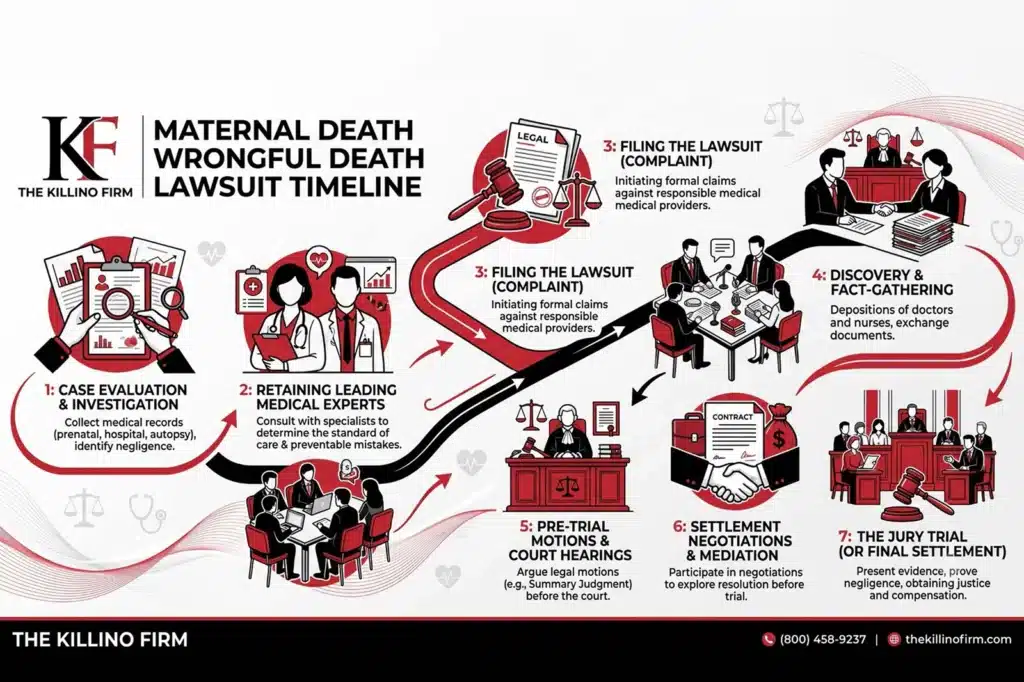
When Do Medical Malpractice Settlements Occur?
While a maternal death case can settle at any point during the litigation process—even before a formal lawsuit is filed or mid-way through a trial—the most significant settlements are generally secured when corporate defense teams are forced to face the overwhelming strength of the plaintiff’s evidence.
Our team utilizes several critical litigation pressure points to compel maximum compensation from negligent healthcare systems:
- Following Expert Disclosure: When defense counsel reviews the comprehensive affidavits and formidable credibility of our nationally recognized maternal-fetal medicine experts, liability becomes exceedingly difficult to contest.
- Following Defendant Depositions: When attending physicians, nurses, or hospital administrators are aggressively deposed and make damaging admissions under oath regarding their failure to escalate care.
- On the Eve of Trial: When the unpredictability of a jury, combined with the threat of public exposure of the hospital’s systemic failures, creates pressure for corporate risk management to resolve the case.
Cases that ultimately proceed to a jury verdict usually involve defendants who outright refuse to accept liability or instances where the defense refuses to offer a settlement that fairly reflects the extraordinary damages suffered by the family. The Killino Firm prepares every single maternal death case from day one as if it will be tried in court. Corporate hospitals and their insurance carriers know we possess the resources and the resolve to stand before a jury and expose their negligence, which is the exact leverage required to secure a full and fair recovery.
The Single Most Important Action a Family Can Take
Contact our experienced maternal death attorneys before your state’s statute of limitations expires. Once that legal window closes, most of the time no amount of compelling evidence or egregious hospital conduct can revive your claim. Deadlines vary strictly by state, and the clock starts ticking immediately.
Call The Killino Firm today. Our national team will conduct a free, confidential review, secure the evidence before it disappears, and pursue maximum recovery with no upfront cost to your family. You pay nothing unless we win.
The process is long. The work is hard. And we do it every day for families who deserve justice.
About The Killino Firm Team
The Killino Firm is a nationally recognized maternal death, catastrophic injury and wrongful death practice dedicated to fighting for families who have lost a mother to preventable obstetric negligence. Founded by Attorney Jeffrey Killino, our firm has spent over two decades prosecuting complex medical malpractice cases against hospitals and healthcare systems that place cost and convenience above patient safety.
We build complex maternal death cases from the ground up—retaining world-class forensic economists, child psychologists, and maternal-fetal medicine experts to ensure every dimension of a family’s loss is documented and pursued without compromise. Our commitment to trial readiness has produced hundreds of millions of dollars in recoveries and secured accountability verdicts that force negligent institutions to change the practices that cost a mother her life. No hospital system should profit from a preventable death, and no grieving family should leave value on the table.