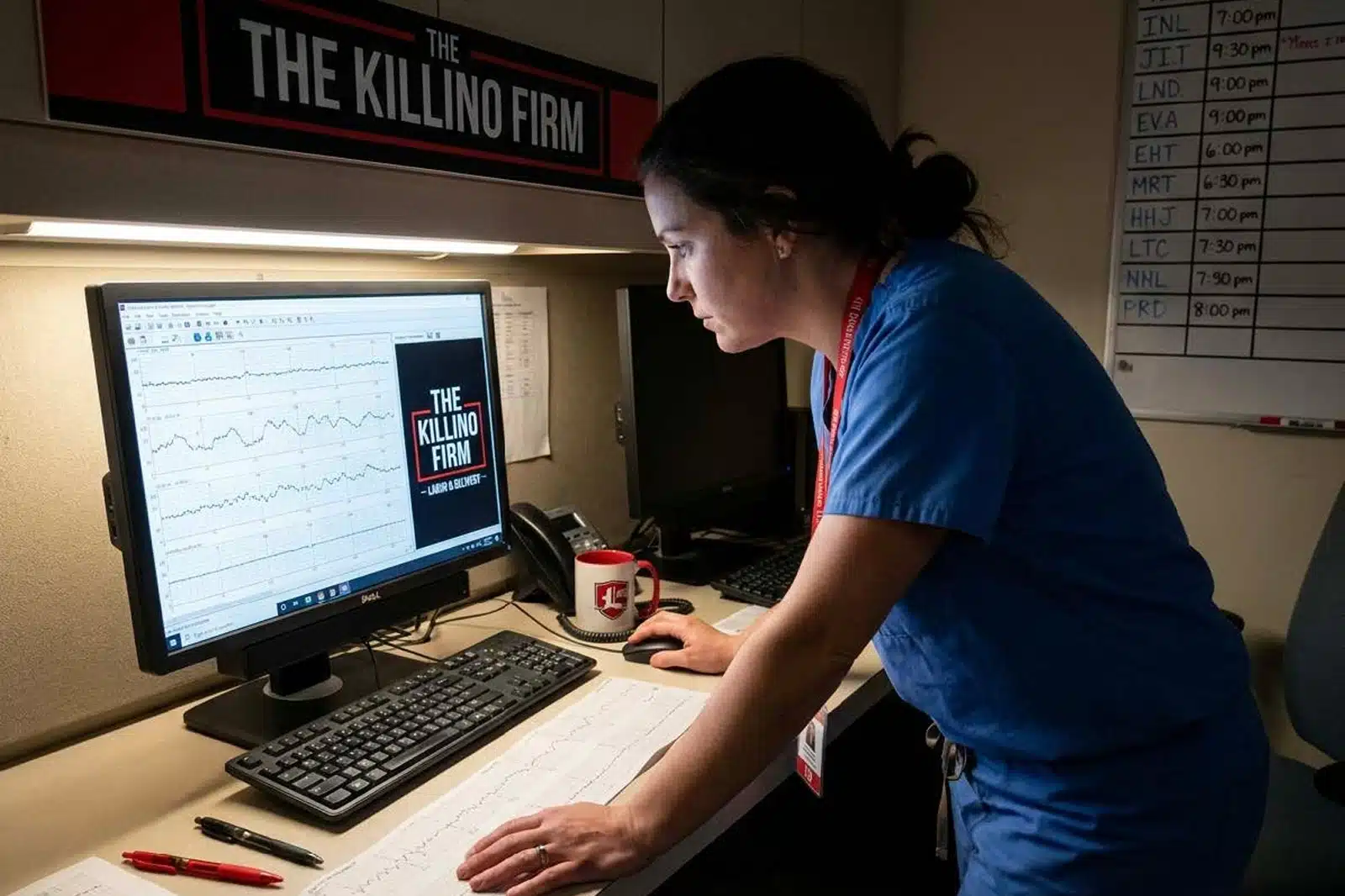
Obstetric negligence during labor and delivery occurs when a doctor, nurse, or hospital fails to meet the accepted standard of medical care — and that failure causes serious injury or death to a mother, her baby, or both. The warning signs are often visible in real time: abnormal fetal heart rate strips that go unaddressed, hemorrhage that escalates without intervention, or a C-section that is ordered too late to prevent catastrophic harm. Families who recognize these signs — or who suspect they were ignored — may have a wrongful death or birth injury claim that may demand immediate legal investigation. Families who lose a mother to a preventable childbirth complication can learn more about maternal death claims.
Key Takeaways
- You have legal rights if a healthcare provider’s failure to monitor, diagnose, or act caused injury or death during labor and delivery.
- Nurses and physicians share accountability — negligence can originate with any member of the obstetric team, including anesthesiology and hospital administration.
- Medical records tell the story. Fetal monitoring strips, nursing notes, and physician orders can be the primary evidence in every obstetric malpractice case.
- Delay is dangerous. Evidence is lost, witnesses’ memories fade, and hospital systems routinely preserve documentation only for required retention periods.
- The Killino Firm offers a free, confidential lawyer review with no obligation to proceed.
What Should Labor and Delivery Nurses Be Monitoring Throughout Active Labor?
Registered nurses in labor and delivery are required by the standard of care to continuously monitor fetal heart rate patterns, maternal vital signs, contraction frequency and duration, and any signs of maternal or fetal distress — and to document all findings in real time. Gaps in monitoring or failure to escalate abnormal findings to the attending physician are among the most common — and most litigable — forms of obstetric negligence.
According to the American College of Obstetricians and Gynecologists (ACOG), nurses managing laboring patients must assess and document:
- Fetal heart rate (FHR) — continuously via electronic fetal monitoring (EFM) in high-risk pregnancies, or intermittently per facility protocol in low-risk patients
- Maternal blood pressure — at minimum every 30 minutes in active labor, and every 15 minutes in the second stage; more frequently for patients with hypertensive disorders
- Uterine contractions — frequency, duration, and intensity, with documentation of any signs of tachysystole (too-frequent contractions that compromise fetal oxygen supply)
- Maternal temperature and oxygen saturation — elevated maternal temperature is an early indicator of chorioamnionitis (infection of the amniotic membranes), a condition that demands immediate physician notification
- Vaginal bleeding — any bleeding beyond expected show requires immediate assessment and physician notification
- Patient-reported symptoms — headache, visual disturbances, epigastric pain, and shortness of breath are red flags for preeclampsia, pulmonary embolism, or cardiac events
When a nurse fails to take a blood pressure reading, documents falsified or late observations, or fails to call a physician when a patient reports chest pain or severe headache, that breach of duty is exactly the kind of deviation our birth injury team investigates.
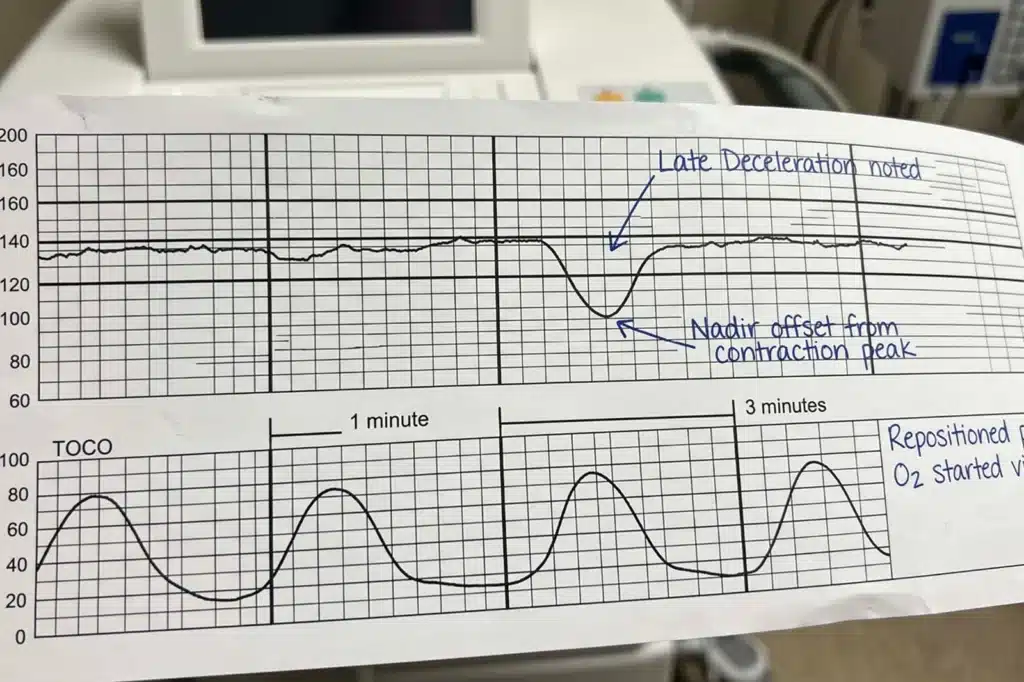
What Fetal Heart Rate Patterns Indicate a Medical Emergency That Requires Immediate Intervention?
These patterns include: Category III fetal heart rate tracings — those showing a sinusoidal pattern, absent baseline variability with recurrent decelerations, or prolonged bradycardia — represent medical emergencies that require immediate physician response, up to and including emergency cesarean delivery. Failure to recognize or respond to these patterns within the accepted timeframes is a textbook breach of the obstetric standard of care.
Electronic fetal monitoring classifications, established by ACOG Practice Bulletin No. 106, define three categories:
- Category I (Normal): Baseline rate of 110–160 bpm, moderate variability, no late or variable decelerations — no intervention required
- Category II (Indeterminate): Does not meet Category I or III criteria — requires continued surveillance, assessment of clinical context, and corrective measures
- Category III (Abnormal): Requires prompt evaluation and, if the pattern cannot be resolved, delivery — typically by emergency C-section
Late decelerations — drops in fetal heart rate occurring after the peak of a contraction — may indicate uteroplacental insufficiency. When they are recurrent and go unaddressed, the fetus is being deprived of oxygen. Every minute of delay in those circumstances is a minute of potential decompensation leading to permanent brain damage.
Our catastrophic injury legal team works with board-certified maternal-fetal medicine experts who review fetal monitoring strips minute by minute. We do not accept a hospital’s characterization of a tracing as ambiguous when the clinical record tells a different story.
When Is a Delayed Cesarean Section Legally Considered Medical Negligence?
Medical professionals face rapidly evolving scenarios during labor and delivery. However, a delayed Cesarean section crosses the threshold into actionable medical negligence when the healthcare team fails to intervene within the timeframe necessitated by the specific obstetric emergency, and that delay directly causes fetal or maternal harm.
The medical standard of care is dictated by the immediate threat to the baby or mother. In catastrophic emergencies—such as an umbilical cord prolapse, severe placental abruption, or uterine rupture—established clinical guidelines demand immediate surgical intervention. Failing to recognize and meet the urgency of these specific threats is where legal liability may arise.
Specific scenarios our birth injury team has successfully litigated include:
- Failure to Recognize Fetal Distress: A physician who interprets a Category III fetal heart tracing as acceptable, continues oxytocin augmentation, and allows a deteriorating labor to proceed for hours rather than ordering an immediate emergency C-section.
- Systemic Institutional Delays: A hospital failing to provide an available operating room, lacking sufficient anesthesia staff, or failing to have an attending surgeon present when an emergency strikes.
- Failing to Intervene During Acute Emergencies: When sudden, life-threatening complications arise—such as an umbilical cord prolapse, severe placental abruption, or signs of uterine rupture—the standard of care dictates a rapid transition to surgical delivery. Permitting a vaginal delivery to continue when emergency surgery is unequivocally required may constitute a clear, legally actionable breach of duty.
In medical malpractice claims across the country, pursuing a catastrophic birth injury or maternal death case requires legal and medical validation. While specific state laws vary, nearly all jurisdictions require plaintiffs to secure an affidavit or certificate of merit—a formal written statement from an independent, licensed physician affirming that the medical provider’s conduct deviated from the accepted standard of care. The Killino Firm retains leading medical experts nationwide and coordinates these mandatory legal certifications as a standard component of every case evaluation.
How Does a Hospital’s Failure to Escalate Patient Concerns Constitute Medical Malpractice?
A hospital may be deemed to breach the standard of care when its nursing or medical staff ignores a laboring mother’s reported symptoms, fails to invoke the chain of command, or dismisses a deteriorating clinical situation. When a failure to evaluate or escalate a patient’s medical complaints directly results in preventable harm, it may constitute actionable medical negligence.
While regulatory standards—such as the Centers for Medicare & Medicaid Services (CMS) Conditions of Participation—mandate that hospitals maintain safe care environments, the clinical duty to protect patients is absolute. The burden of securing timely, competent medical intervention never rests on the family; it is the fundamental legal responsibility of the healthcare facility.
In the labor and delivery setting, hospital staff must adhere to protocols regarding patient advocacy and symptom escalation:
- The Nursing Duty to Invoke the Chain of Command: Obstetric nurses have an independent clinical duty to advocate for the patient. If an attending physician is absent, dismissive, or failing to recognize signs of maternal distress—such as severe chest pain, sudden vision loss, extreme headache, or shortness of breath—the standard of care dictates that the nurse must invoke the hospital’s internal chain of command. This requires immediately escalating the issue to a charge nurse, nursing supervisor, or department chief.
- Physician Bedside Response Requirements: When a nurse reports severe symptoms or abnormal fetal heart rate tracings, the attending physician is required to evaluate the patient at the bedside. A nurse who fails to escalate a deteriorating situation, or a physician who refuses to respond promptly to the bedside, may expose both the individual provider and the hospital to corporate negligence liability.
- The Mandate for Informed Consent & Patient Autonomy: Healthcare providers possess a non-delegable legal duty to secure true informed consent, explaining all clinical risks, benefits, and treatment alternatives. Overriding a mother’s informed decision or failing to provide medically necessary interventions without justification may violate core patient rights and established standards of care.
- Failure to Clinically Evaluate Maternal Symptoms: The dismissal of a mother’s reported symptoms may reflect a documented, systemic issue in American healthcare. In court, the actionable breach occurs when that dismissal leads to a total failure to medically evaluate the patient. When hospital staff fail to investigate maternal complaints—particularly those raised by Black women, who CDC data confirms are three times more likely to die from pregnancy-related causes than white women—they neglect foundational diagnostic requirements. Failing to order appropriate testing, escalate monitoring, or initiate timely interventions in response to reported symptoms constitutes a clear deviation from the standard of care.
Our birth injury team aggressively audits electronic medical records (EMR) and audit trails to prove exactly when clinical warning signs were left unassessed, holding the facility fully accountable for the consequences of medical inaction.

What Are the Most Frequently Missed Signs of Postpartum Hemorrhage in the Delivery Room?
Postpartum hemorrhage — defined as blood loss exceeding 500 mL after vaginal delivery or 1,000 mL after cesarean — is the leading direct cause of maternal death worldwide, yet the World Health Organization reports that the majority of deaths from PPH are preventable with prompt recognition and treatment. The most dangerous failures occur when nursing and medical staff underestimate cumulative blood loss or delay uterotonic drug administration.
The specific deviations our birth injury team uncovers most often in these catastrophic cases include:
- Failure to use quantitative blood loss (QBL) measurement: Visual estimation consistently underestimates blood loss by 30 to 50 percent. ACOG and the Association of Women’s Health, Obstetric and Neonatal Nurses (AWHONN) establish QBL as the requisite standard of care.
- Failure to recognize uterine atony: A soft, non-contracting uterus after delivery may require immediate uterine massage and the administration of oxytocin. Delayed recognition of this condition constitutes a direct nursing failure.
- Failure to Timely Identify the Source and Stop the Bleeding: Failing to promptly investigate and isolate the origin of a maternal hemorrhage may constitute a clear breach of accepted medical protocols. The attending medical team must immediately identify the exact source of the bleeding and execute the indicated pharmacological or surgical interventions to arrest the blood loss before catastrophic injury occurs.
- Failure to timely and adequately resuscitate: Allowing a patient to decompensate into hypovolemic shock without initiating aggressive, immediate volume replacement and blood transfusion protocols may represent a complete breakdown in emergency obstetric care.
- Delayed administration of uterotonic medications: Oxytocin, misoprostol, methylergonovine, and carboprost have specific, appropriate clinical applications. Failing to rapidly escalate through this medication sequence when initial treatments fail may be a definitive medical failure.
- Late transfer to the OR or ICU: A patient experiencing deteriorating vital signs who does not respond to initial hemorrhage management requires immediate surgical escalation. Delaying this transfer can be the difference between maternal survival and death.
- Failure to activate a hemorrhage protocol: Hospitals maintain established massive transfusion protocols for obstetric emergencies. Failing to activate these procedures—or lacking a functional protocol entirely—may represent a systemic institutional failure that exposes both individual providers and the corporate hospital network to legal liability.
How Does The Killino Firm Investigate Suspected Obstetric Negligence?
Our catastrophic injury team conducts one of the most thorough medical-legal investigations available to families anywhere in the country — beginning with a confidential, no-cost review. We have pursued obstetric negligence cases for over two decades, and we understand that winning these cases requires more than legal argument — at a minimum it requires clinical expertise, meticulous record analysis, and the right expert witnesses.
Our investigation process:
Complete medical record acquisition — which can include prenatal records, labor and delivery nursing notes, fetal monitoring strips (the full paper record, not just summary data), anesthesia records, operative reports, postpartum documentation, pathology and autopsy reports, and any incident reports generated by the hospital.
Quantitative fetal strip analysis — Maternal-fetal medicine physicians review the EFM record minute by minute and identify the precise moment the standard of care required intervention.
Chain-of-command review — we reconstruct who knew what, when, and what action was or was not taken, including whether charge nurses and attending physicians were contacted as required.
Hospital policy comparison — we obtain the facility’s own labor and delivery protocols and measure actual conduct against them; when the hospital’s own policies were violated, that can be powerful evidence.
Independent expert testimony — we retain obstetricians, neonatologists, nurses, and life-care planners as required by each state’s rules of evidence and expert disclosure requirements.
The Killino Firm works on a contingency fee basis — families pay nothing unless we recover on their behalf.

What Should a Family Do Right Now If They Suspect Obstetric Negligence Caused a Death or Injury?
Time is the variable families cannot recover once it is lost. Take these steps immediately:
Request all medical records in writing — hospitals must produce records under HIPAA, and doing so promptly preserves evidence before retention periods expire.
Write down every detail from memory — names of every provider involved, every concern raised, every response given, and the precise timeline of events.
Do not sign any release, settlement offer, or liability waiver presented by the hospital, its insurer, or its risk management department without first consulting a lawyer.
Contact The Killino Firm at 878-678-9016 for a free, confidential consultation — we will evaluate the medical facts, explain your legal options, and will connect you with the clinical experts needed to assess the case.
Statutes of limitations dictate the exact time limit you have to file a lawsuit, typically beginning on the date of the injury or death. These legal deadlines are strictly enforced by courts nationwide. While the specific time frame varies significantly from state to state—ranging anywhere from one to six years depending on your jurisdiction and the nature of the case—the consequence of missing the window is universal: if the deadline passes, your right to pursue a claim and recover compensation can be permanently lost.
The Killino Firm has represented families nationwide. There is no cost to contact us, no obligation to proceed, and no fee unless we win.
About The Killino Firm. The Killino Firm is a nationally recognized maternal death, catastrophic injury and wrongful death law practice with over two decades of experience holding negligent hospitals, physicians, and healthcare systems accountable for preventable maternal and birth injuries. Advocating fiercely for injured patients—often earning recognition on local and national news programs—the firm’s legal team has recovered hundreds of millions of dollars for families devastated by obstetric negligence. This includes successfully handling complex cases involving postpartum hemorrhage, delayed C-sections, and the failure to recognize fetal distress. The Killino Firm is driven by a relentless commitment to uncovering the clinical truth behind every case and fighting for the families who trusted a hospital with a mother’s life.