A wrongful death lawyer represents surviving family members or an estate in seeking compensation after a death caused by another party’s negligence or fault. For families trying to understand their rights after losing a loved one, wrongful-death claims can involve strict standing rules, complex damages calculations, contested liability and causation, procedural deadlines, insurance limitations, and governmental immunities. Understanding a fatal-injury claim requires evaluating two distinct legal pathways: a wrongful-death action, which seeks compensation for eligible survivors’ losses, and a survival action, which preserves claims for damages the deceased sustained before death. Recovering compensation requires proving liability and damages, which may involve biomechanical and accident-reconstruction analysis, as well as forensic-economic modeling of lost future earnings.
Navigating the claims process also involves overcoming key procedural hurdles, including comparative fault defenses, statutory liability caps, and strict notice deadlines set by state or federal law.
Key Takeaways
- Two Related Claims: A wrongful-death action generally seeks damages for losses suffered by eligible survivors, while a survival action preserves claims the deceased could have pursued before death.
- Complex Valuation: Future financial support, lost earning capacity, benefits, and household services may require economic analysis and supporting evidence.
- Strict Deadlines: Statutes of limitations vary by jurisdiction and claim. Claims involving governmental entities may also require an administrative notice or claim before suit.
- Technical Proof: Accident reconstruction, biomechanical, medical, and other expert evidence may help evaluate the cause of fatal injuries, but no single type of evidence establishes liability by itself.

What Is the Difference Between Wrongful-Death and Survival Actions?
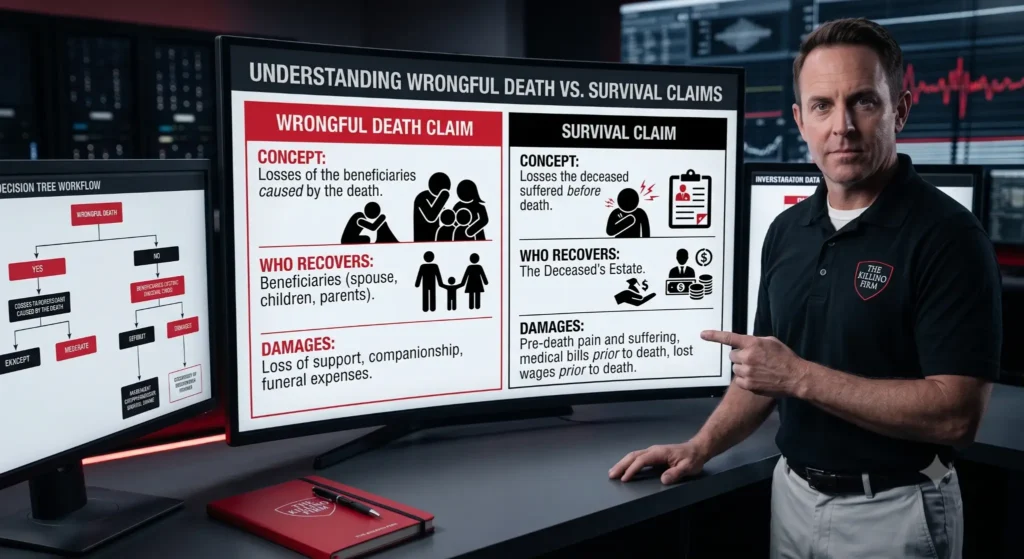
Wrongful death lawsuits are civil claims that may be treated as a type of personal injury claim when the injured person dies. Depending on the jurisdiction, eligible claimants may include a surviving spouse, children, parents, or other specified relatives or dependents.
Potential damages may include:
- Lost financial support;
- Loss of companionship or consortium;
- Lost household services;
- Medical and funeral expenses, where authorized; and
- Other damages permitted by applicable law.
Eligible survivors may seek compensation for their own losses through a civil lawsuit.
A survival action is typically brought by the decedent’s personal representative on behalf of the decedent’s estate or the deceased person’s estate. A wrongful death attorney may represent the estate and surviving family members when the death resulted from legal fault. A wrongful death suit usually focuses on losses suffered by survivors, while the survival action preserves the deceased person’s own pre-death claims. It preserves claims belonging to the deceased person, which may include medical expenses and conscious pain and suffering before death, if permitted by state law. Funeral expenses and other damages are allocated differently across jurisdictions and should not be treated as universally recoverable in a survival action.
The two claims may arise from the same event, but they can involve different claimants, damages, filing requirements, and distribution procedures. Our wrongful death lawyers handling personal injury cases can explain who may file and how a successful claim may pursue financial compensation.
How May Defendants and Insurers Challenge Wrongful-Death Claims?
When liability or settlement is disputed, the insurance company and defendants may challenge liability, causation, damages, or the claimant’s eligibility to recover. Common issues include:
- Comparative Fault: The defense may argue that the deceased contributed to the incident. Depending on the jurisdiction, that finding may reduce recovery or bar it altogether.
- Causation: Defendants may contend that a pre-existing condition, an intervening event, or another cause—not the defendant’s conduct—caused the death.
- Insufficient Evidence: Defendants may challenge physical evidence, medical records, expert opinions, or the account of the accident.
- Pre-Suit Communications: An insurance company may seek recorded statements or other information early, often before counsel is involved, and counsel often handles those communications. Families should understand the potential consequences before providing substantive statements.
Our legal team may seek to preserve relevant evidence, communicate with insurers, and protect the family’s interests. Once litigation is reasonably anticipated, parties may have obligations to preserve relevant electronic and physical evidence under applicable law. In civil cases, families may also recover damages even if no criminal case is brought or a conviction does not occur, because a wrongful death claim is separate from criminal prosecution and seeks civil recovery rather than criminal punishment. Proving liability often requires showing that the at fault party is the person or entity whose negligence caused the death and is typically named as the defendant.
How May Accident and Biomechanical Evidence Be Used?
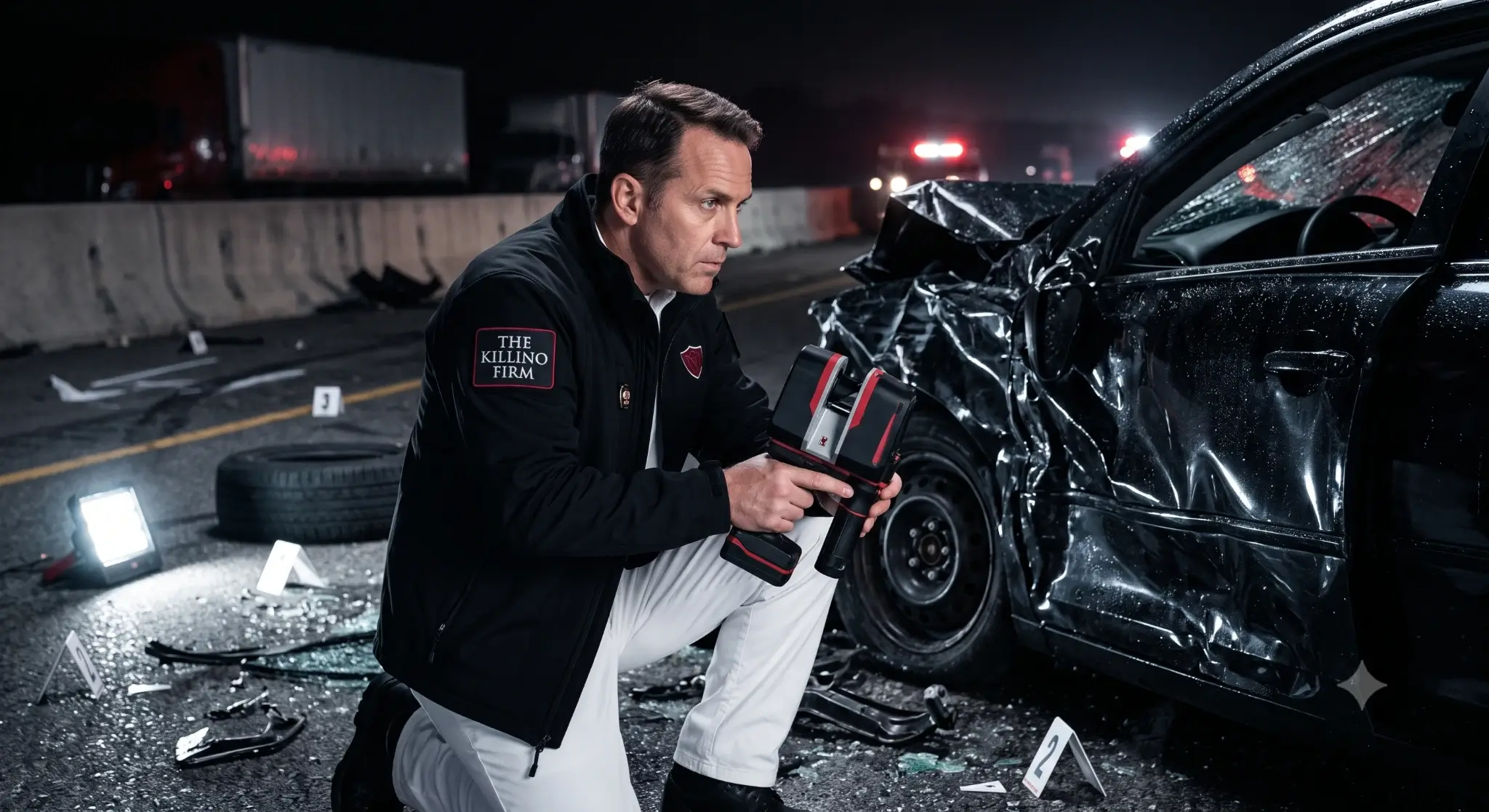
Accident reconstruction and biomechanical evidence may assist in evaluating vehicle movement, occupant kinematics, impact forces, injury mechanisms, and medical causation in a wrongful death case arising from car accidents,, fatal accidents, or other motor vehicle accidents. Wrongful death cases may also arise from defective products or medical malpractice, although different proof may be required. Experts may consider:
- Delta-v: The change in a vehicle’s velocity during a collision;
- Vehicle data: Event data recorder information, telematics, braking, speed, and steering data, when available and admissible;
- Vehicle and scene evidence: Damage patterns, roadway conditions, photographs, and inspections; and
- Medical evidence: Autopsy findings, imaging, treatment records, and physician opinions relevant to causation analysis, including whether a negligent act or omission contributed to the fatal injuries and potential medical negligence issues.
National Highway Traffic Safety Administration materials and other technical sources may inform an analysis, but they do not automatically establish causation or liability in a particular case. Expert opinions must satisfy the applicable evidentiary requirements, including those governing reliability, methodology, and helpfulness to the factfinder.
What Role Do Forensic Economists Play?
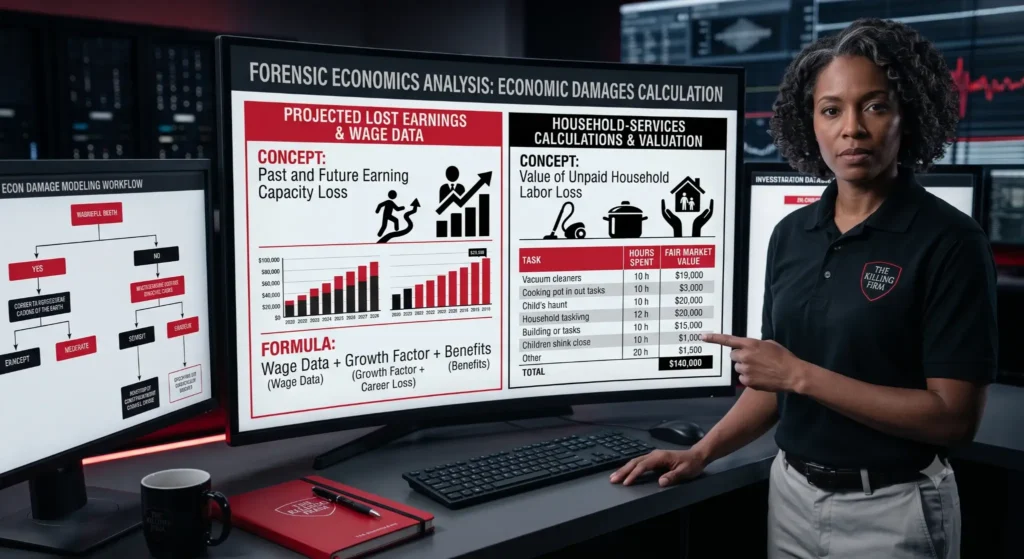
Forensic economists may estimate financial losses associated with a death in wrongful death lawsuits.. Their analyses may consider:
- Expected earnings and work-life expectancy;
- Career advancement and wage growth;
- Employer-provided benefits, retirement contributions, and insurance;
- Taxes, personal consumption, and other economic assumptions;
- lost wages; and
- The replacement value of household services, such as childcare, home maintenance, and administrative work.
Damages may also include medical bills and, where allowed, the loss of emotional support provided by the deceased.
The recoverability and calculation of these losses depend on the governing law, the evidence, and the assumptions used by the experts. Economic projections are estimates, not guarantees. Whether there is a successful wrongful death claim or other successful claim depends on the governing law and proof of damages.
Frequently Asked Questions
1. Who May File a Wrongful-Death Lawsuit?
Each state has its own wrongful death statute governing who may bring a wrongful-death claim. Eligible claimants commonly include immediate family members such as a surviving spouse, children, parents, other family members, a family member, specified relatives, dependents, or the personal representative of the estate, depending on state law. The answer depends on the jurisdiction and the circumstances of the death. Some states require the decedent’s estate, rather than individual relatives, to bring the wrongful death lawsuit after a loved one’s death.
2. How Long Do Families Have to File?
The statute of limitations depends on the claim, jurisdiction, defendant, and applicable tolling or discovery rules. Although some statutes provide one- to three-year limitations periods, others provide different deadlines. The statute of limitations varies by state. Claims involving governmental entities may require a notice or administrative claim before suit, so acting quickly helps protect legal rights.
For claims under the Federal Tort Claims Act, an administrative claim generally must be presented to the appropriate federal agency within two years after accrual. If the agency denies the claim, suit generally must be filed within six months after the denial is mailed.
3. What If the Deceased Was Partly at Fault?
The result depends on the governing fault rules. In a pure comparative-fault jurisdiction, damages may be reduced by the deceased’s percentage of fault. In a modified comparative-fault jurisdiction, recovery may be reduced or barred when fault reaches the applicable statutory threshold. Some jurisdictions apply contributory negligence rules that may bar recovery for any legally significant fault, subject to exceptions.
4. How Do Insurance Limits Affect Recovery?
Policy limits may affect what an insurance company pays under a policy, even if the at-fault defendant’s total liability is greater. After the death occurred, coverage may come from one or more policies depending on the facts. Counsel may investigate additional insurance, excess or umbrella coverage, multiple defendants, employer liability, statutory caps, and the collectability of a judgment.
5. Can the Estate Recover if the Victim Survived for a Period After the Injury?
Potentially. Where authorized by state law, the estate may recover damages through a survival action if the victim survived for a time after the injury, including losses the deceased sustained before death, such as medical expenses and conscious pain and suffering. These are losses the deceased could have pursued before death, similar to claims in a personal injury case. The evidence must establish the nature and duration of the pre-death losses.
6. How Are Settlement Proceeds Distributed?
Distribution depends on the governing statute, the identity of the claimants, the settlement agreement, court approval requirements, probate procedures, liens, and other applicable rules. Intestate-succession rules do not automatically govern every wrongful-death distribution.
7. What Role Can Federal Highway Standards Play?
Federal Highway Administration standards and other roadway-safety materials may be relevant evidence in some claims involving roadway design, maintenance, or construction. They do not automatically establish a state-law duty, breach, or liability. Sovereign-immunity rules, statutory requirements, and the specific facts determine their legal significance.
8. Can a Civil Claim Proceed While Criminal Charges Are Pending?
Generally, a wrongful-death claim proceeds separately as a civil lawsuit, even when criminal charges are pending. Criminal cases can lead to jail time or other penalties, while wrongful death claims seek financial compensation. A civil claim ordinarily requires proof by a preponderance of the evidence, rather than proof beyond a reasonable doubt. Pending criminal proceedings may nevertheless affect discovery, privilege, timing, and litigation strategy. Even without a criminal conviction, families may still prove wrongful death under the civil standard.
9. What Are a Corporation’s Evidence-Preservation Obligations?
Once litigation is reasonably anticipated, a party may have a duty to preserve relevant evidence, including driver logs, vehicle telemetry, electronic communications, inspection records, and internal reports. Whether spoliation occurred and what remedy may be available depend on the applicable law and the facts. In federal litigation, electronically stored information is addressed in part by Fed. R. Civ. P. 37(e). Counsel may send a preservation notice identifying potentially relevant evidence, but a notice alone does not create every preservation obligation or guarantee that evidence will be retained.
About The Killino Firm Legal Team
The Killino Firm’s wrongful death lawyers serve families after a loved one’s death in complex wrongful-death and catastrophic-injury matters. The Killino Firm helps clients understand their legal rights and the legal process, and empathy and communication skills matter in these cases. We may work with medical professionals, accident-reconstruction specialists, engineers, and forensic economists when appropriate to investigate liability, causation, and damages. Our trial experience is important in wrongful death lawsuits that do not settle.
Every case is different. Past results do not guarantee or predict a future outcome. The availability and amount of any recovery depend on the facts, applicable law, evidence, insurance or other sources of recovery, damages, and collectability.
Learn more about The Killino Firm’s practice and contact the firm for a confidential case evaluation and free consultation.