Commercial Driver’s License (CDL) holders operating large trucks and commercial motor vehicles (CMVs) in Philadelphia are subject to some of the most unforgiving distracted driving laws in the United States. These mandates go far beyond the rules applied to standard passenger car drivers. Families in Philadelphia who have lost a loved one in a similar way can speak with a Philadelphia wrongful death lawyer about their options.
With the recent end of the state’s warning grace period, commercial truckers face a double-bind of strict federal oversight and fully enforceable state hands-free laws. A CDL holder caught manually operating a mobile device faces steep fines, immediate safety record black marks, and potentially career-ending disqualifications.
If a distracted commercial driver has injured you or a loved one on I-95, the Schuylkill Expressway, or any local roadway, proving a violation of these strict standards is foundational evidence of negligence.
Key Takeaways
- The Federal Mandate: Federal regulations strictly ban all handheld cell phone use by CDL drivers operating commercial motor vehicles—including reading, dialing, and texting—under 49 CFR § 392.82.
- The New PA Standard: Pennsylvania’s newly enacted Paul Miller’s Law (75 Pa. C.S. § 3316.1) enforces a complete statewide ban on holding or supporting any interactive wireless device while driving.
- Active Citations Live: As of June 2026, Pennsylvania’s initial 12-month warning-only grace period has officially expired. Officers are actively issuing full-penalty citations for handheld device use as a primary offense.
- Strict Disqualifications: A single federal violation can disqualify a CDL driver for 60 days; a second violation within three years triggers an immediate 120-day suspension.
- Direct Carrier Liability: Motor carriers bear independent corporate liability if they fail to enforce mandatory distracted driving safety policies, fail to monitor fleet behavior, or ignore a driver’s prior cellular violations.
What Federal Laws Prohibit Cell Phone Use by CDL Drivers?
Federal oversight ensures that commercial drivers maintain undivided attention while moving heavy freight through dense urban environments. The Federal Motor Carrier Safety Administration (FMCSA) enforces two distinct safety regulations that eliminate any ambiguity regarding mobile device usage.
1. Handheld Device Prohibition (49 CFR § 392.82)
Under 49 CFR § 392.82, a commercial trucker is strictly prohibited from using a handheld mobile phone while driving. The law explicitly defines “driving” to include moments when the truck is temporarily stationary due to traffic jams, red lights, or construction delays. Prohibited actions include:
- Dialing a phone number by pressing more than a single button.
- Holding a mobile phone to or near the ear.
- Reaching for a mobile device in a manner that requires moving out of a properly secure, seatbelted position.
2. Comprehensive Texting Ban (49 CFR § 392.80)
Separately, 49 CFR § 392.80 bans all manual text-based communications. Truck drivers cannot write, send, or read standard SMS text messages, emails, instant messages, or web notifications while operating a CMV.
These federal regulations leave no gray area: any manual interaction with a phone while commanding an 80,000-pound tractor-trailer constitutes an explicit safety violation.
The New Pennsylvania Framework: Paul Miller’s Law
For years, Pennsylvania’s distracted driving laws lagged behind federal standards by primarily targeting text messaging under the old terms of 75 Pa. C.S. § 3316. That landscape has completely changed with the full implementation of Paul Miller’s Law (75 Pa. C.S. § 3316.1).
[ OLD PENNSYLVANIA LAW ]
Banned only text-based messaging.
Left massive loopholes for browsing,
dialing, and holding devices.
│
▼
[ NEW PAUL MILLER'S LAW ]
Complete ban on ALL handheld phone actions.
Primary offense: Police can pull you over
simply for having a phone in your hand.
Named in honor of a 21-year-old university student tragically killed by a distracted trucker, this statute makes holding or supporting an interactive wireless device with any part of the body a primary offense. This means police officers in Philadelphia have absolute authority to pull a driver over solely for holding a phone.
Following a year-long educational warning phase, full enforcement with active citations and cash fines is entirely live. For commercial drivers, a conviction under Section 3316.1 is automatically recorded on their permanent commercial driving record as a non-sanction safety violation. Furthermore, if a distracted driver causes an accident resulting in a fatality, the new statutory framework allows courts to impose an additional five years of mandatory prison time for homicide by vehicle.
Fines and Disqualifications Facing Distracted CDL Drivers
The penal matrix designed by federal and state authorities is structured to systematically remove distracted operators from the labor pool.
|
Violation Tier
|
Penalties for the CDL Driver
|
Corporate Penalties for the Motor Carrier
|
|---|---|---|
|
First Offense
|
Up to a $2,750 federal civil penalty, a state cash fine, and an immediate 60-day CDL disqualification if a second serious traffic violation occurs.
|
Up to an $11,000 civil penalty for allowing or requiring a driver to operate a handheld device.
|
|
Second Offense (Within 3 Years)
|
Second Offense (Within 3 Years) Mandatory 60-day to 120-day CDL disqualification; recording of serious traffic violation on permanent record.
|
Downward revision of FMCSA safety ratings; increased safety intervention tracking.
|
|
Third Offense (Within 3 Years)
|
Mandatory 120-day disqualification per violation; potential for permanent operating bans.
|
Publicly searchable safety interventions; high threat of operational authority suspension.
|
These rigid penalty structures reflect staggering empirical data. Research published by the Federal Motor Carrier Safety Administration (FMCSA) indicates that a commercial truck driver who texts while driving is 23 times more likely to trigger a safety-critical event—such as a rollover, collision, or accidental lane departure—than an attentive driver. Merely reaching for a mobile device increases a trucker’s crash risk by 6.7 times.
Beyond the Cell Phone: Broader Forms of Local Negligence
While cellular devices are the most common distraction target, Pennsylvania case law and Philadelphia traffic enforcement recognize that a commercial driver’s negligence can stem from any behavior that diverts their visual, manual, or cognitive attention from the highway. Our investigative teams scrutinize multiple alternative sources of distraction, including:
- Manually programming physical GPS displays or mobile routing systems while the truck is in motion on corridors like Columbus Boulevard or the Delaware Expressway.
- Reviewing paper shipping manifests, bills of lading, or delivery documentation while navigating heavy city traffic.
- Interacting with fleet management dispatch systems or onboard entertainment configurations while moving.
- Eating or drinking while maneuvering through the tight intersections of Center City or the I-676 connector.
In a Philadelphia personal injury lawsuit, any action that breaks a driver’s required focus at the exact moment of impact serves as powerful proof of a failure to exercise reasonable care.
Securing the Digital Evidence: Subpoenas and Telematics
Cell phone data and digital logs provide objective proof of liability. Unlike witnesses, electronic records cannot misremember or alter their story. However, this critical evidence is highly time-sensitive and can be easily overwritten or erased without immediate legal intervention.
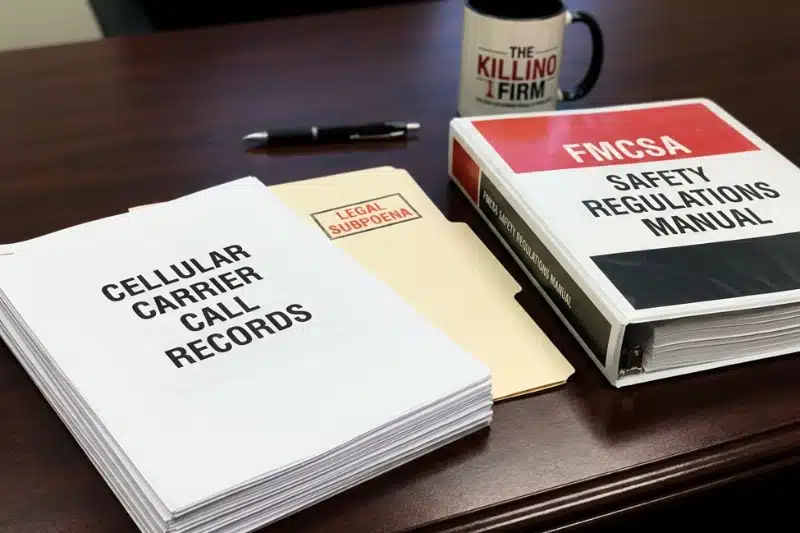
Subpoenaing Cellular Carrier Logs
Our truck accident litigation team moves immediately to serve formal legal subpoenas directly to wireless service providers to lock down:
- Call Detail Records (CDRs): Tracking the exact second a voice call was initiated, accepted, or terminated.
- Data Transmission Logs: Revealing precisely when a mobile device opened a data connection to send an SMS, load a webpage, or receive an app notification.
- Application Usage Logs: Identifying if social media, navigation, or personal chat platforms were actively processing user inputs at the time of the crash.
Cross-Referencing Onboard Fleet Telematics
Modern commercial fleets operating along the East Coast are outfitted with comprehensive telematics systems (such as Samsara, Omnitracs, or Motive). We issue formal spoliation demands to extract this data, cross-referencing cellular timestamps against real-world mechanical behaviors:
If a motor carrier allows this telematics history or internal driver-facing AI camera footage to overwrite after receiving a formal preservation notice, we invoke Pennsylvania’s spoliation doctrine under Pennsylvania Rule of Civil Procedure 4019. This empowers local judges to issue adverse inference instructions, telling the jury to assume the destroyed data could have proved the driver’s phone use caused the crash.
Navigating Corporate Carrier Liability in Philadelphia Courts
When a distracted trucker triggers a catastrophic collision, legal responsibility does not end with the driver. Under Pennsylvania law, injured victims can file direct civil actions against the employing trucking company under several distinct corporate liability theories:
- Respondeat Superior (Vicarious Liability): Holding the carrier fully liable for the careless actions of their driver while on the clock.
- Negligent Supervision and Training: Actionable when a carrier fails to monitor its drivers’ mobile device habits or fails to mandate compliance training regarding Paul Miller’s Law.
- Negligent Hiring and Retention: Proving the trucking company kept an operator behind the wheel despite knowing they possessed a documented history of prior cell phone violations or serious safety infractions.
- Negligence Per Se: Establishing that the carrier openly allowed or encouraged a direct violation of federal safety mandates, effectively locking in corporate liability before a Philadelphia jury.
Major commercial claims are aggressively litigated within the Philadelphia County Court of Common Pleas at 34 S. 11th Street. If the carrier is based out of state, the litigation may proceed in federal court at the U.S. District Court for the Eastern District of Pennsylvania at 601 Market Street.
Because corporate insurance policies scale significantly higher than standard passenger car coverage, defense firms will deploy rapid-response teams to mitigate evidence. Protecting your rights requires an equally fast, sophisticated legal response.
Urgent Evidence Preservation Warning
We Advance All Upfront Investigative Costs—No Fee Unless We Win. Cell phone tower pings, fleet telematics loops, and commercial dashcam data are routinely purged within 30 to 90 days. Waiting even a few weeks to initiate an independent investigation can result in the permanent destruction of the exact data needed to secure a fair recovery.
The Killino Firm handles all catastrophic commercial carrier claims on a contingency fee basis. Our team covers 100% of the upfront costs of subpoenaing cellular networks, securing black box downloads, and retaining accident reconstruction experts. You pay absolutely nothing out of pocket, and we charge no legal fees unless we win your case.
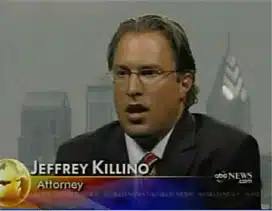
About Attorney Jeffrey Killino
Jeffrey Killino is the founder of The Killino Firm, an elite catastrophic injury practice dedicated to dismantling aggressive corporate defense strategies. Attorney Killino and his team recognize that a mobile device in a truck driver’s hand at highway speeds isn’t an oversight—it is a catastrophic hazard. His firm coordinates immediate field investigations, cell carrier subpoenas, and forensic telematics extractions to hold distracted commercial operators and negligent motor carriers fully accountable for the harm they inflict on Philadelphia’s roadways.
This is provided for informational purposes only and does not constitute formal legal advice. Reading this page does not create an attorney-client relationship. If you or a family member has been injured by a commercial vehicle in Pennsylvania, contact The Killino Firm directly for a confidential, no-cost consultation.