Hundreds of Millions of Dollars Have Been Recovered for Personal Injury and Wrongful Death Victims
"*" indicates required fields
A wrongful death claim is a civil lawsuit that arises when a person dies due to the negligence or wrongful act of another party. Wrongful death occurs when a person dies due to the negligence or misconduct of another person or party.
If you have found your way to this page, the unimaginable has likely happened. Whether you are searching for a San Francisco wrongful death lawyer or simply trying to understand your options, this resource guide is for families in San Francisco who have lost a loved one and are seeking legal guidance on wrongful death claims. We cover the legal process, common causes, who can file, damages, and how our firm can help.
San Francisco is a city of breathtaking beauty—from the fog rolling over the Golden Gate to the vibrant chaos of the Mission District. But when you lose someone you love suddenly, that beauty feels distant. The cable cars keep running, the tech buses keep shuttling, but your world has come to a screeching, painful halt. The emotional and legal consequences of a loved one’s death can be overwhelming, leaving families searching for answers and justice.
At The Killino Firm, we recognize that you aren’t looking for another script—you are looking for the truth. When a death is preventable, the “whys” can sometimes be more agonizing than the loss itself. Our role is to step into that space of uncertainty, providing the forensic investigation and legal weight necessary to transform your search for answers into a pursuit of accountability.
This resource is designed to provide Bay Area families with the factual clarity and straightforward answers necessary to navigate the aftermath of a fatal accident. You need to understand what happened, why San Francisco is such a unique landscape for accidents, and what the law can actually do to help you pick up the pieces.
A wrongful death claim is a special type of lawsuit that arises when a person dies as a direct result of the negligence or wrongful act of another person, company, or entity. In California, a wrongful death isn’t just a tragedy; it is a specific legal claim. A wrongful death claim is a civil claim, separate from any criminal prosecution, and is focused on holding the responsible party accountable and securing compensation. It arises when a person dies because of someone else’s negligence, recklessness, or intentional act. Whether it was a distracted driver on 19th Avenue, a medical error at a UCSF facility, or a defective product that failed in your home in the Sunset, the law says that when negligence steals a life, the deceased person’s family or heirs have a legal right to be made whole.


In San Francisco, wrongful death claims are shaped by the city’s dense, vertical geography and its role as a global technology and transit hub. When a life is lost due to negligence in the Bay Area, the investigation must look beyond simple accidents to the systemic failures unique to our “City by the Bay.”
While San Francisco saw a record 42% decrease in traffic fatalities in 2025, the risk remains heavily concentrated. Data from the San Francisco Municipal Transportation Agency (SFMTA) reveals that roughly 76% of fatal and severe injuries occur on the “High Injury Network”—a mere 12% of the city’s streets.
In these corridors, such as Mission Street, Market Street, and the 19th Avenue arterial, the primary cause of wrongful death is “Speeding on Arterials” and a failure to yield to vulnerable users. San Francisco’s seniors are particularly at risk; in 2025, while overall pedestrian deaths fell, seniors accounted for nearly three-quarters of all pedestrian fatalities. When we investigate a fatal collision in these zones, we examine whether the driver’s speed was amplified by the city’s failure to implement “daylighting” or signal-hardening measures that were previously identified as necessary for safety.
The Bay Area’s constant state of vertical growth makes construction and industrial incidents a leading cause of preventable death. According to 2025 Bureau of Labor Statistics reports, the construction sector remains the most hazardous industry in California, with specialty trade contractors accounting for the majority of fatal injuries.
In San Francisco’s high-rise projects and infrastructure repairs, the “Fatal Four”—falls, struck-by objects, electrocutions, and caught-in-between incidents—are the primary drivers of wrongful death claims. We look specifically for Cal/OSHA violations; if an employer or a third-party subcontractor bypassed fall protection standards or failed to secure heavy machinery on a steep San Francisco grade, that negligence forms the basis of our pursuit for accountability.
In a city where public transit, commercial delivery vehicles, and residents occupy the same narrow footprint, premises liability takes on a different meaning. We see wrongful death claims arising from:


San Francisco is unique. We are a dense, hilly, transit-heavy city squeezed onto a peninsula. That geography, combined with a bustling population, creates specific dangers that we see over and over again in our cases.
Here is a statistic that very few people discuss until it affects them: The City of San Francisco has identified the “High Injury Network.” According to Vision Zero SF, just 13% of the city’s streets account for 75% of severe and fatal traffic crashes.
San Francisco is defined by transit. We have MUNI, BART, and the massive private shuttles (the “tech buses”) navigating narrow, Victorian-lined streets.
The Foundation of Standing: Legal and Blood Relationships
In San Francisco, the legal right to bring a wrongful death action is governed by a concept known as standing. Rather than a wide-open door for anyone who is grieving, California law acts as a strict filter, ensuring that only those with a specific legal or financial tether to the deceased can initiate a claim.
San Francisco has diverse household structures and a high population of unmarried partners. Establishing this connection is the first hurdle in any Bay Area case. The law recognizes the right to seek justice based on the following connections:
San Diego’s diverse community includes many blended families and domestic partnerships whose lives are deeply intertwined. Beyond traditional marriage, California law extends the right to file a claim to those who can demonstrate a significant financial reliance. Under California Code of Civil Procedure § 377.60, the legal system includes individuals who relied on the deceased for at least 50% of their financial support, ensuring that all those impacted by a loss have a formal pathway to seek justice.


While the law cannot reverse a tragedy, the civil justice system serves as a critical mechanism for stabilizing a family’s shattered infrastructure. In a high-cost environment like San Francisco, the loss of a primary earner or a dedicated caregiver creates an immediate and compounding financial crisis. A wrongful death claim is designed to address this void, securing the resources necessary to maintain your household—whether that means keeping a home in Noe Valley or ensuring that a child’s long-term educational path remains uninterrupted.
By pursuing these damages, we aren’t just looking at a settlement figure; we are calculating the “lifetime value” of the support that was stolen. This includes the projected earnings, retirement benefits, and the tangible value of the daily household services your loved one provided. In the Bay Area, where the cost of living leaves little room for error, these legal protections act as a vital safeguard for your family’s future, ensuring that a single act of negligence does not result in a lifetime of financial hardship.
In the San Francisco Courts, damages fall into two main categories:
In the Bay Area’s complex economy, “hard costs” extend far beyond a simple calculation of lost wages. We collaborate with forensic economists to build a comprehensive model of the deceased’s total economic contribution, ensuring that the final demand reflects the high-stakes reality of living and working in this region.
Note: In California wrongful death cases, you generally cannot recover for your own grief or mental anguish. The jury is instructed to value the relationship that was lost, not the tears you cry. However, if you witnessed the death happen (like being in the car during the crash), you may have a separate claim for “Negligent Infliction of Emotional Distress.” This is why you need an experienced team to analyze every angle.


In many wrongful death cases, a local trauma center—such as Zuckerberg San Francisco General or UCSF Medical Center—is simply where a loved one’s story reaches its conclusion. While we review those records to document the severity of the trauma, the emergency room is rarely the most important factor in the legal outcome. Our focus remains firmly on the initial accident that caused the injury, rather than the medical care that followed.
The clinical data from the ER provides the “how,” but the accident scene reveals the “why.” Our investigation begins on the streets, piers, and jobsites of San Francisco, where the fatal negligence actually occurred. We look far beyond the hospital walls to reconstruct the critical moments preceding the emergency room—whether it was a catastrophic Muni derailment, a fatal pedestrian impact on Market Street, or a high-stakes premises liability incident at the Port.
By prioritizing the mechanics of the collision and the failure of safety protocols at the scene, we focus our resources on the root cause of the tragedy. We don’t just document the final outcome; we prove the negligence at the source to ensure that the parties truly responsible are held fully accountable.


The legal battle is our job. Your job is healing. San Francisco has a uniquely strong network of support organizations to help you navigate the darkness of grief.
Seeking support from these organizations is an essential step in your emotional recovery. From a legal perspective, engaging with these groups can also help illustrate the profound human impact of your loss. While a civil claim addresses the financial void, these resources address the emotional healing that is equally critical to your family’s future.


According to the 2026 SFMTA High Injury Network update, fatal accidents remain heavily concentrated on just 12% of city streets. Current “red zones” include:
Yes. Data from 2025 and 2026 shows that seniors (aged 70+) are the most vulnerable group in the city. While overall traffic deaths have dropped, seniors account for nearly three-quarters of all pedestrian fatalities. If a loved one was a senior killed while crossing a city street, our investigation focuses on whether the city’s “Senior Safety Zones” were properly maintained or if signal timing failed to accommodate slower walking speeds.
Absolutely. San Francisco is the global testing ground for driverless technology. In 2026, liability for these accidents often falls under Product Liability rather than standard driver negligence. We look at the vehicle’s sensor data and proprietary algorithms to prove that the technology failed to detect a pedestrian or misread a construction zone. These cases often involve suing the manufacturer (like Waymo or Cruise) directly.
It can. By the end of 2026, San Francisco is required to have “daylighted” every intersection—meaning parking is prohibited within 20 feet of a crosswalk to ensure visibility. If a fatal accident occurred because a parked car blocked a driver’s view of a pedestrian, we investigate whether the city or the vehicle owner violated these visibility standards.
Yes. Because Muni is a government-run agency, you must navigate the California Tort Claims Act. This means you have a much shorter deadline—only six months—to file a formal notice of claim. Furthermore, we investigate the “Operator Logs” to see if driver fatigue or a failure in the Muni’s specialized braking system contributed to the tragedy.
San Francisco’s recently expanded speed camera program provides a new level of evidence. If a fatal crash occurred in a zone equipped with these cameras, we can subpoena the metadata to prove exactly how fast the at-fault driver was going—often neutralizing their “I was going the speed limit” defense immediately.
Yes. As the city sees more “powered devices” on the streets, fatal collisions between scooters and pedestrians are becoming a reality. These claims can involve the rider’s personal liability or a claim against the rental company if the device had a mechanical failure, such as brake or throttle malfunctions.
Frequently. Many fatal accidents in neighborhoods like Nob Hill or Potrero Hill involve “Runaway Vehicle” or “Gravity-Fed” incidents. In these cases, we investigate whether a commercial vehicle was properly “curbed” or if a failure in a vehicle’s parking brake system—often a result of poor maintenance—was the true cause of the loss.
In 2026, the city formally adopted the Street Safety Initiative, which recognizes that traffic deaths are a result of poor system design. If a loved one was killed in an area where the city had already identified a need for “Quick-Build” safety improvements but failed to install them, the city’s inaction may be used as evidence of a “Dangerous Condition of Public Property.”
Not always. While Workers’ Comp provides some benefits, it is rarely enough for a family’s long-term survival. In the Bay Area’s high-rise construction and tech-campus projects, fatal incidents often involve Third-Party Negligence. If a subcontractor, equipment manufacturer, or property owner other than the employer contributed to the death, you can file a full wrongful death lawsuit to recover far more than Workers’ Comp allows.
If you have lost a loved one in San Francisco or the surrounding Bay Area, you don’t have to navigate this alone. We will listen to your story, answer your questions, and help you find a path toward justice.
Disclaimer: The information provided in this article is for general informational purposes only and does not constitute legal advice. Every case is unique. Please consult with an attorney to discuss the specifics of your situation.


We contacted this firm when our son suffered a birth injury. They listened to our potential case and took us on. They helped us all the way through the process, always took my calls and questions. Killino is very passionate about his work and it felt like he was upset for our son like he was his own child. The paralegal, Kayla, was always on top of things and helpful. The whole firm that we worked with really did their best for us and now we have what we need to care for our son. We couldn’t be more grateful.
Jeff and his team at Killino Law Firm are truly exceptional! They took on my daughter’s challenging case when no one else would, and their dedication, expertise, and compassion made all the difference. Thanks to their amazing work, we can now take care of our daughter for the rest of her life. Jeff handled everything with professionalism and kept us informed every step of the way. If you’re in need of a personal injury & accident lawyer, look no further—Jeff is your guy. I can’t recommend him and his exceptional team enough!
The Killino firm is an excellent firm that tirelessly advocates on behalf of their clients. I’ve come across a lot of great personal injury attorneys in my time and simply put, Killino is the best.
Courtney S

Reggie B
Corey E
Jeanne Y
Trisha H
Michaelene C
Rhonda L
In the aftermath of a wrongful death or catastrophic injury, particularly those involving babies and children, victims and their families are forced into the new “normal”. Their lives are often characterized by multiple facets of struggle; physical, medical and financial. The worry and stress can be unbearable. But, that is where the Killino Firm steps in.
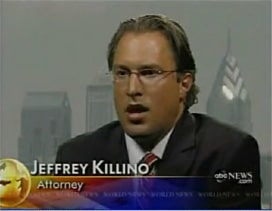
Time and again for over two decades Jeffrey Killino has changed the lives of his clients and their families with recoveries that will provide for all future medical care and day to day needs. The Killino Firm clients are regularly purchasing new homes and vehicles; securing much needed medical care and assistance; and sleeping better at night know there are millions of dollars to take care of them for the rest of their lives.
Yes, the Killino Firm regularly secures multi-million dollar settlements and/or verdicts, however, we measure our true success in terms of how we change our clients’ lives. The Killino Firm is dedicated to its clients and their plight. After the cases are over, the Killino Firm stays involved and available to it’s clients as the journey continues.
At the Killino Firm we care about our clients and we care about our community, which is why from time to time when we uncover a hazard or danger with the potential to harm others, the Killino Firm takes action to alert the public and appropriate regulatory authorities.
Call Me
We'll call you!
"*" indicates required fields
By submitting, you agree to be contacted about your request & other information using automated technology. Message frequency varies. Msg & data rates may apply. Text STOP to cancel. Privacy Policy
Text With Us
We'll text you!
"*" indicates required fields
By submitting, you agree to be contacted about your request & other information using automated technology. Message frequency varies. Msg & data rates may apply. Text STOP to cancel. Privacy Policy
Call Me
We'll call you!
By submitting, you agree to be contacted about your request & other information using automated technology. Message frequency varies. Msg & data rates may apply. Text STOP to cancel. Privacy Policy
Text With Us
We'll text you!
"*" indicates required fields
By submitting, you agree to be contacted about your request & other information using automated technology. Message frequency varies. Msg & data rates may apply. Text STOP to cancel. Privacy Policy
Email Us
We're available by email!
"*" indicates required fields
By submitting, you agree to be contacted about your request & other information using automated technology. Message frequency varies. Msg & data rates may apply. Text STOP to cancel. Privacy Policy
Book A Consultation
We're ready to answer your questions!
