NATIONALLY RECOGNIZED
Hundreds of Millions of Dollars Have Been Recovered for Catastrophic Injury and Commercial Vehicle Accident Victims
"*" indicates required fields
When someone is injured in a ride-share vehicle, there are multiple layers of insurance coverage. For claims against the responsible rideshare driver, Uber and Lyft insurance policies operate under a strict, three-tiered insurance framework dictated entirely by the driver’s mobile application status at the exact moment of impact. The Killino Firm details victims’ legal rights, insurance structures, recoverable damages, and civil litigation procedures for Uber and Lyft car accident and assault cases. Designed specifically for survivors and their families, these insights provide essential information to help victims understand their rights and maximize financial compensation after a traumatic event. This framework matters because rideshare cases involve intricate insurance policies and liability issues, where corporate coverage depends entirely on the driver’s active status in the app at the exact time of the incident.


These key points provide a foundation for understanding the unique challenges and opportunities in rideshare litigation. We’ll explore how insurance coverage is structured for Uber and Lyft accidents.

Rideshare corporate liability across the United States operates under a strict, three-tiered insurance framework dictated entirely by the driver’s mobile application status at the exact moment of impact.
When a driver is offline or the app is closed (Stage 1), corporate commercial insurance provides no coverage, forcing claims to proceed under the driver’s personal auto policy, which may be denied if commercial use is discovered.
Once a driver turns the app on and is awaiting a digital match (Stage 2), corporate policies activate a lower, state-mandated contingency liability pool—typically requiring a minimum baseline of $50,000 per person and $100,000 per accident for bodily injury, alongside $25,000 for property damage. This exact tier of coverage is explicitly outlined in the official insurance programs maintained by major transportation network platforms, such as the Uber Driver Insurance Overview and the Lyft Insurance Resources Directory.
The highest level of coverage activates the moment a driver accepts a digital match or transports a passenger (Stage 3). This stage triggers a mandatory $1 million commercial liability policy wrapper, as verified in the official Uber Commercial Insurance Policy Guide and the Lyft Driver Insurance Matrix. This $1 million limit applies universally, whether the victim is a passenger, pedestrian, or motorist in another vehicle.
The three-tiered approach discussed is only for claims against rideshare drivers. If you bring direct claims against Uber or Lyft for (negligent hiring, negligent retention, failure to train, and failure to monitor), the claims would be subject to Uber’s own insurance or self-insurance coverage, which is likely far higher than the $1M that they provide to drivers. These direct claims aren’t only for sexual assaults. You can bring them for normal ride-share crash cases too.
While statutory frameworks standardized by state legislatures regulate these Transportation Network Companies (TNCs) based on real-time digital activity to prevent corporations from hiding behind “independent contractor” status, regional variations exist. For instance, unique statutory exceptions apply to specialized regional operations, such as the strict regulations governing Taxi and Limousine Commission (TLC) drivers in New York. Ultimately, proving the exact digital footprint of the driver’s phone remains crucial to establishing which tier applies and forcing insurance syndicates to honor the maximum policy limits available under the law.
However, claims brought directly against Uber and Lyft themselves are different – and so is the insurance coverage. Many serious rideshare injury cases also include direct negligence claims against Uber or Lyft themselves, and not just the driver. These claims usually allege that Uber or Lyft contributed to the person’s injuries by:
In some states, Uber and Lyft can also be held directly responsible for the level of control they exercise over the rideshare driver.
These claims brought directly against Uber and Lyft are generally not limited to the $1 million rideshare liability policy associated with the driver. Instead, they may be covered under Uber and Lyft’s much larger insurance or self-insurance limits.


Victims can recover comprehensive economic and non-economic damages, including immediate emergency medical bills, projected future surgeries, medical expenses, lost wages, and physical pain and suffering. Victims should also seek prompt medical attention, both to get proper treatment and to document their injuries. When a crash results in a permanent, life-altering disability, our catastrophic injury legal team collaborates with independent forensic economists to calculate the present-value lifetime cost of necessary home modifications and diminished earning capacity. These meticulous financial models ensure that final trial verdicts or settlements provide complete long-term security for the injured individual and their family. Documentation of medical expenses is crucial when victims file claims after a rideshare crash.


Our firm draws on decades of high-stakes courtroom experience to craft bulletproof damages presentations, ensuring that corporate insurance defense lawyers cannot minimize or devalue your physical losses during discovery.
After understanding the types of damages available, it’s important to know how victims can hold rideshare corporations accountable for assaults and violence.


Sexual assault survivors may pursue a sexual assault case against rideshare companies through civil lawsuits, and our experienced sexual assault lawyers can provide legal representation based on negligent hiring, negligent retention, and vicarious corporate liability. By demonstrating that a tech corporation utilized flawed background checks or ignored continuous safety red flags regarding a specific driver, litigators can pierce the corporate shield. These lawsuits seek to punish corporate indifference and uncover hidden internal safety communication logs during the formal discovery process.


Rideshare giants repeatedly claim that they cannot control the criminal actions of independent drivers. However, general common law principles available via the Legal Information Institute (LII) dictate that a corporation owes a fundamental duty of safety to the consumers it deliberately pairs through its proprietary software and must take reasonable steps to protect passengers. When a driver uses the app to trap, kidnap, or sexually assault a passenger, rideshare companies must screen out sexual predators and face direct exposure when foreseeable threats are allowed to remain active.


When prosecuting an assault case, our catastrophic injury legal team subpoenas the driver’s complete onboarding file, historical rating records, and all prior safety flags. If the corporate tracking system shows the driver had previous complaints for stalking or inappropriate behavior and the platform failed to deactivate the account, the corporation is directly liable for negligent retention.
The prevalence of such incidents highlights the importance of understanding the national statistics and trends in rideshare safety.
Corporate safety disclosures and unsealed multi-district litigation records reveal that thousands of severe safety incidents, including sexual assaults, deadly crashes, and Lyft sexual assault claims, occur across rideshare networks annually. Notably, unsealed documents from ongoing national multi-district litigation reveal that one major rideshare entity received a report of sexual assault or safety misconduct approximately every eight minutes on average over a multi-year span. These figures demonstrate a systemic failure in corporate screening protocols that directly endangers vulnerable passengers day and night.
With these risks in mind, it’s essential to understand the procedural rules for filing a rideshare injury lawsuit.


Filing a rideshare personal injury or assault lawsuit requires strict adherence to jurisdictional venue rules, insurance claims procedures, and the respective state statutes of limitations where the incident occurred. Plaintiffs often choose to file in federal court under diversity jurisdiction rules or seek consolidation within nationwide Multidistrict Litigation (MDL) frameworks when challenging systemic corporate safety protocols. Missing these procedural rules or failing to file a comprehensive complaint within the mandatory state window permanently terminates the victim’s right to pursue financial damages, and in no-fault states, some claims must be filed within 30 days.
Filing within a highly favorable jurisdiction provides distinct advantages, as juries are historically known for holding multi-billion dollar entities fully accountable for safety failures. However, corporate defense teams will aggressively attempt to transfer cases to restrictive environments using forum non conveniens motions. We counter these tactics by immediately establishing the corporation’s extensive economic footprint and digital transactions within the target jurisdiction, identifying each responsible party, and clarifying legal responsibility.
Before litigation begins, it is vital to preserve all relevant evidence, which is why sending a spoliation of evidence letter is a critical first step.


An emergency spoliation-of-evidence letter legally compels a rideshare corporation to preserve transient digital logs, cellular metadata, police reports, and internal communication records that would otherwise be automatically destroyed or overwritten. This immediate formal notice protects vital crash metrics, including exact vehicle speed, braking telemetry, gyroscopic forces, and real-time app interactions by the driver, and it should also identify the parties involved and the other driver when applicable. Under standard civil evidentiary law, if a corporate defendant deletes or alters this data after receiving a spoliation demand, the court can issue an adverse inference instruction allowing a jury to presume the destroyed evidence proved corporate guilt.
Our firm commands absolute authority in this space. Our firm’s national record of taking on multi-billion-dollar corporations ensures that when our spoliation letters reach corporate legal departments, their compliance teams know that any destruction or overwriting of data could trigger a devastating adverse inference instruction in open court, allowing a jury to legally presume the destroyed evidence proved corporate liability.
With evidence preserved, the next step is to understand how a nationwide catastrophic injury firm can defeat the deep-pocketed legal teams representing rideshare technology giants.


Defeating the multi-billion-dollar legal infrastructure of Silicon Valley technology giants requires a law firm possessing massive independent financial resources, elite forensic experts, and an unyielding history of courtroom success. Our catastrophic injury legal team matches corporate defense strategies step-for-step by forcing corporate executives into depositions under Federal Rule of Civil Procedure 30(b)(6) and utilizing independent accident reconstructionists. We build every single claim from day one as a trial-ready asset, and we fight for our clients on a contingency fee basis, refusing to accept undervalued settlement offers from corporate insurance syndicates.
This relentless trial preparation is why corporate defendants recognize our name and understand that we will never back down until your family receives absolute justice.
For those seeking experienced legal representation, it’s important to know the background and expertise of your attorney.
The primary difference is the regulatory environment. Commercial vehicle cases involve federal laws (FMCSR), significantly higher insurance policy limits, and multiple potential defendants (carrier, broker, loader), whereas car accidents are usually limited to state traffic laws and the individual driver.
Yes, in most cases—but the rules vary significantly by state.
Determining fault in a commercial vehicle accident is rarely black and white. While you may feel partially responsible, the law looks at the degree of negligence compared to the professional standards required of a commercial truck driver. Because commercial vehicle companies are held to higher federal safety standards (FMCSR), their failure to follow regulations often outweighs a minor driver error on your part.
However, your ability to collect damages depends on which of the three legal frameworks your state follows:
Commercial drivers are held to a stricter BAC limit (0.04%) than standard drivers (0.08%). If a driver tests positive for controlled substances, it may open the door for punitive damages against the commercial vehicle company for failing to implement mandatory drug-testing programs.
Due to the complexity of the investigation and the high stakes involved, commercial vehicle cases can take several months to several years. Resolving the case too early can be a mistake, as the full extent of long-term medical needs may not be clear in the first few months.
Value is determined by “Damages.” This includes medical bills, future care costs, lost earning capacity, and non-economic factors like pain and suffering. We often use vocational experts and life-care planners to calculate these figures accurately.
The Electronic Control Module (ECM) records critical data such as speed, hard braking, and seatbelt usage. This data provides an objective “witness” to the crash that cannot be influenced by the commercial vehicle company’s narrative.
Many commercial fleets now use dual-facing dashcams. This footage is discoverable in a lawsuit and can prove driver fatigue (nodding off) or distraction (looking at a phone) leading up to the collision.
We investigate the maintenance records. If the blowout was caused by a “recapped” tire used on the front axle (which is illegal) or a failure to replace worn tread, the maintenance provider and carrier are liable.
This occurs when a commercial vehicle company allows a driver behind the wheel who they knew (or should have known) was dangerous due to a history of accidents, a lack of license, or failed drug tests.
Federal law requires a minimum of $750,000 in liability insurance for general freight, but many carriers carry $1 million to $5 million or more. This is much higher than standard $25,000 or $50,000 auto policies. Insurance coverage limits can impact the compensation available in commercial vehicle accident cases, with commercial vehicle companies required to carry a minimum of $750,000 in insurance.
Yes. Jackknife accidents are almost always the result of driver error (braking incorrectly on a curve) or mechanical failure (improperly adjusted brakes), both of which are grounds for a claim.
Adjusters for commercial vehicle companies are trained to secure admissions of fault or record statements that minimize your injuries. Their goal is to close the case for the lowest possible amount before you understand your legal rights.
commercial vehicle accident cases are highly complex and require an experienced commercial vehicle lawyer who understands federal regulations, industry standards, and the tactics used by commercial vehicle companies and their insurers. While personal injury attorneys may handle a variety of cases, an experienced v lawyer brings knowledge, trial experience, and legal strategy tailored to commercial vehicle litigation, which can make a significant difference in the outcome of your case.
Yes, we offer a free consultation to all potential clients. This no-cost, no-obligation case evaluation allows you to discuss your situation with our legal team, understand your rights, and learn how we can help—before making any commitment.
We contacted this firm when our son suffered a birth injury. They listened to our potential case and took us on. They helped us all the way through the process, always took my calls and questions. Killino is very passionate about his work and it felt like he was upset for our son like he was his own child. The paralegal, Kayla, was always on top of things and helpful. The whole firm that we worked with really did their best for us and now we have what we need to care for our son. We couldn’t be more grateful.
Jeff and his team at Killino Law Firm are truly exceptional! They took on my daughter’s challenging case when no one else would, and their dedication, expertise, and compassion made all the difference. Thanks to their amazing work, we can now take care of our daughter for the rest of her life. Jeff handled everything with professionalism and kept us informed every step of the way. If you’re in need of a personal injury & accident lawyer, look no further—Jeff is your guy. I can’t recommend him and his exceptional team enough!
The Killino firm is an excellent firm that tirelessly advocates on behalf of their clients. I’ve come across a lot of great personal injury attorneys in my time and simply put, Killino is the best.
Courtney S

Reggie B
Corey E
Jeanne Y
Trisha H
Michaelene C
Rhonda L
In the aftermath of a wrongful death or catastrophic injury, particularly those involving babies and children, victims and their families are forced into the new “normal”. Their lives are often characterized by multiple facets of struggle; physical, medical and financial. The worry and stress can be unbearable. But, that is where the Killino Firm steps in.
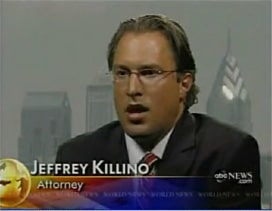
Time and again for over two decades Jeffrey Killino has changed the lives of his clients and their families with recoveries that will provide for all future medical care and day to day needs. The Killino Firm clients are regularly purchasing new homes and vehicles; securing much needed medical care and assistance; and sleeping better at night know there are millions of dollars to take care of them for the rest of their lives.
Yes, the Killino Firm regularly secures multi-million dollar settlements and/or verdicts, however, we measure our true success in terms of how we change our clients’ lives. The Killino Firm is dedicated to its clients and their plight. After the cases are over, the Killino Firm stays involved and available to it’s clients as the journey continues.
At the Killino Firm we care about our clients and we care about our community, which is why from time to time when we uncover a hazard or danger with the potential to harm others, the Killino Firm takes action to alert the public and appropriate regulatory authorities.
Call Me
We'll call you!
"*" indicates required fields
By submitting, you agree to be contacted about your request & other information using automated technology. Message frequency varies. Msg & data rates may apply. Text STOP to cancel. Privacy Policy
Text With Us
We'll text you!
"*" indicates required fields
By submitting, you agree to be contacted about your request & other information using automated technology. Message frequency varies. Msg & data rates may apply. Text STOP to cancel. Privacy Policy
Call Me
We'll call you!
By submitting, you agree to be contacted about your request & other information using automated technology. Message frequency varies. Msg & data rates may apply. Text STOP to cancel. Privacy Policy
Text With Us
We'll text you!
"*" indicates required fields
By submitting, you agree to be contacted about your request & other information using automated technology. Message frequency varies. Msg & data rates may apply. Text STOP to cancel. Privacy Policy
Email Us
We're available by email!
"*" indicates required fields
By submitting, you agree to be contacted about your request & other information using automated technology. Message frequency varies. Msg & data rates may apply. Text STOP to cancel. Privacy Policy
Book A Consultation
We're ready to answer your questions!
