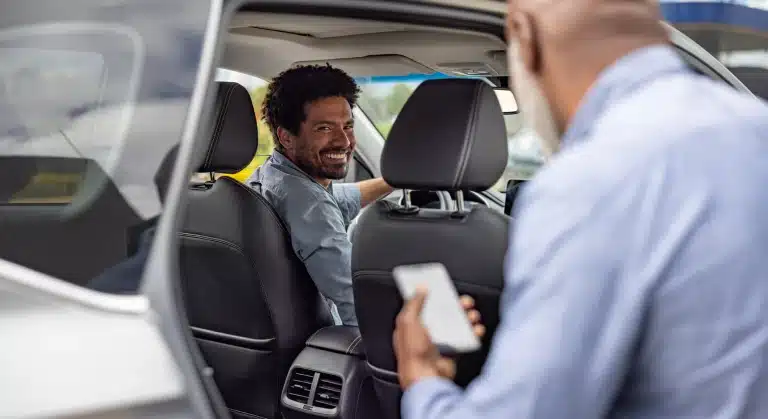
Rideshare crashes rarely involve a single, obvious defendant. Your driver, the rideshare company itself, another motorist, and even a vehicle manufacturer can all share responsibility for what happened. Determining who is ultimately responsible for paying the claim can be more complicated than establishing how the crash happened.
The three common liability scenarios
Many rideshare accident claims fall into one of three patterns:
- Your rideshare driver caused the crash while working, whether waiting for a match or actively transporting you.
- Another driver caused the crash while you rode as a passenger, leaving you with a claim against the at-fault driver’s insurance.
- Fault is shared between your driver and another motorist, which triggers your state's comparative negligence rules.
Each scenario points to a different insurance policy and, often, a different legal strategy. Determining which policy applies — and holding the right insurer accountable — is essential to securing full compensation for your injuries.
Why "independent contractor" status complicates corporate liability
Uber and Lyft structure their relationships with drivers as independent contracting arrangements rather than traditional employment. That classification can make it harder to hold the companies automatically responsible for a driver’s negligence.
Under the doctrine of respondeat superior, employers can be held liable for wrongful acts committed by employees within the scope of their work. Rideshare companies often rely on their drivers’ contractor status to argue that this form of vicarious liability does not apply to them.
That defense is not always conclusive, though, and courts may still examine the actual relationship between the company and the driver when deciding who can be held accountable.
When courts look past the contractor label
A driver’s contract does not always decide whether Uber or Lyft can be held responsible for a crash. In some states, courts also look at how much control the company has over the driver’s work.
That can include factors such as driver ratings and deactivation, control over fares and payments, access to ride requests, vehicle requirements, and location tracking. No single factor decides the issue, and the rules differ from state to state.
If a court finds that the company exercised enough control to create an agency relationship, Uber or Lyft may face greater liability for the driver’s conduct. Because courts apply these rules differently from state to state, an attorney with rideshare accident experience may be better equipped to identify which arguments apply.

Direct negligence claims against Uber and Lyft
Even when vicarious liability does not apply, a direct claim against the rideshare company can still proceed when the platform’s own conduct contributed to the crash. Common grounds include:
- Negligent hiring or retention of an unsafe driver
- Inadequate background screening or driver qualification systems
- Failure to train drivers or monitor their conduct
- Failure to enforce basic safety protocols
These direct claims are not limited by the driver’s $1 million policy. They may draw instead on Uber’s or Lyft’s own corporate insurance or self-insurance coverage, which is typically far larger. Our Uber Rideshare Accidents page walks through how these corporate negligence claims are built and pursued.
How the driver's app status affects the picture
Whether the driver was offline, waiting for a ride request, or actively transporting a passenger determines which insurance framework applies to the claim. A driver who caused a crash while logged off is treated very differently under the law than one who caused a crash mid-trip. Our detailed breakdown of insurance coverage for rideshare passengers explains exactly how these stages work and what coverage attaches to each one.
Other parties who may share responsibility
Liability doesn’t always stop with the two drivers involved. Depending on the facts, additional parties may include:
- The at-fault third-party driver, if that driver caused or contributed to the crash involving your rideshare vehicle
- A vehicle manufacturer, if a defective part such as a tire, brake system, or airbag contributed to the collision — an area where The Killino Firm has built a national reputation, including litigation that forced a federal recall of 450,000 defective tires
- A government entity, if a dangerous roadway condition or defective traffic control played a role, though claims against public agencies often carry much shorter notice deadlines than ordinary personal injury claims

What happens to your claim if you were partly responsible?
If you contributed to the crash in any way, your state’s comparative negligence rule decides how much that matters. Some states cut off your recovery entirely once you cross a 50- or 51-percent fault threshold; others reduce your award proportionally no matter your share of fault. This rule directly affects the final value of your claim.
Proving fault requires fast action
GPS records, in-app trip data, and vehicle telematics establish exactly when a driver logged on, accepted a ride, and picked up a passenger. Rideshare companies do not preserve this data indefinitely, and critical proof can be overwritten within weeks of a crash. Sending an immediate legal demand to preserve evidence (often called a spoliation letter) helps protect these details before they disappear. Our guide on filing deadlines for rideshare accident lawsuits explains why acting quickly protects both your evidence and your legal rights.
How The Killino Firm investigates liability
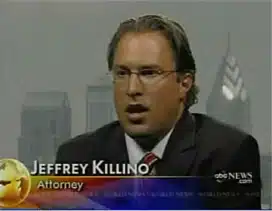
Attorney Jeffrey Killino and our national trial team request driver onboarding files, telematics data, and internal safety records to identify every liable party. Rideshare corporations deploy well-funded legal teams to deflect responsibility onto independent contractors, and we bring comparable investigative resources and courtroom experience to counter that strategy.
If you were hurt in a rideshare crash and aren’t sure who’s responsible, our team can review the facts at no cost. Visit our Uber Rideshare Accidents page or call us 24/7 at (878) 888-7878 for a free, confidential case evaluation.
The information provided on this site is not formal legal advice. Prior results do not guarantee a similar outcome. No attorney-client relationship is formed until a formal agreement is signed. Clients are not responsible for legal fees or expenses unless a financial recovery is obtained.